How to recognize a pearl’s quality. Part 1: nacre thickness

Sep 8
Posted by admin Filed in Harvest, Quality

Combining a Cortez Pearl with the skills and design of Carlos CabralWe now commence a new blog-delivery with a new subject: pearl quality.  How can we view this from the client’s standpoint?  Let us ask the following questions: Why should it should I pay more for higher quality?  What do I get in exchange?

And the answer should be clear and concise: quality gives you value and beauty.  In the case of gems this should be of real importance, because these products must keep their beauty and their value in 5 or 10 or 200 years.  A gem that loses its beauty also loses its value

How can we measure pearl quality?  That is a very interesting question and one we hope to be able to answer in an easy and precise manner.  In the meantime, we will tell you about a critical indicator of pearl quality: nacre thickness and we will see why this indicator is this so important.  But first let us begin this post with a couple of stories…

A Life Investment

Beautiful Hindu Woman wearing a lot of jewelry

Beautiful Hindu Woman wearing a lot of jewelry

For millennia, human beings have purchased precious stones and metals, as well as jewelry and ornaments – made with these materials- for their personal use and enjoyment.  Jewelry items are not only used as adornments or to establish “status” amongst people; they can also serve as a manner of “safe-guard” in moments of crisis.  As an example, in many countries women adorn themselves with lots of jewelry and this can be of a great advantage at times: imagine that at moments of social unrest or economic struggle, that a family has to flee for their lives, keeping only what the family is wearing? Of course, you may own a pair of fancy tennis shoes, but that will not be enough to feed the family or pay a ransom, but your mother’s jewelry may be enough to help the family get on its feet again.  Of course there’s also the question of quality: it would be better to possess a single high-quality –valuable- item, than 20 kilos of costume jewelry (it will not even allow you to run faster). Under this logic let us examine a relatively well documented case.

On October 1917 -during the Russian revolution- the new Bolshevik government began arresting all Russian nobility. This meant that the aristocrats fled their country, leaving behind their palaces, land, clothes and furniture, keeping with them only those items which had great value and were easily carried and hidden.  Amongst these Russian nobleman was Prince Alexander Yousopoff (better known for his part in the assassination of Rasputin) who fled to Paris with some family jewels.  Amongst his most precious treasure he had a pearl necklace (that some assumed had many Sea of Cortez pearls, due to the voracity Russian nobility had for fine pearls) that might have belonged to his mother, Princess Zenaida Youssopova. During his final stay in France, his economic problems became greater and finally –in 1922- he decided to sell this pearl necklace (it might be the one that appears in his mother’s portrait, although without the famous “La Regente” pearl, also known as “Napoleón’s Pearl”, because this pearl has its own unique story). The sale was done by prestigious jeweler Pierre Cartier, who was able to sell the pearl strand to a rich American heiress at a value of $400,000 U.S. dollars.

Princess Zenaida Yusupova, wearing "La Regente" Pearl and an incredible pearl necklace.

To be honest with you all, this story might have some contradicting leads (which I believe just adds a detectivesque flavor to it) and you may want to dig deeper into the story…just like treasure hunting.  Some -like this reference- lead us to think that the pearl necklace might have originally belonged to Catherine “The Great” of Russia, but the necklace could’ve been part of the Imperial Russian treasury, although it is said but the jewelry was found by the Bolsheviks, hidden within a  wall in one of the imperial palaces of the Romanov dynasty. In order to have a more coherent story we are using the information found in the “Cortez Pearl” website as valid.

Nacre thickness and pearl quality

For us, one of the main attributes to take into consideration is nacre thickness.  To understand what this is all about, we can ask the following question: How much of your pearl is really pearl?  Let us analyze this.

Most marine –or salt-water- cultured pearls are produced by the introduction of a small shell-bead -by means of a special surgery- inside the pearl oyster’s body, and over a length of time –the culture period- the little bead will become coated by millions of thin nacre layers, deposited one over the other (in the likeness of an onion) until the pearl is harvested. Under a short culture period (4 to 8 months) the pearl will have a thin nacre coating, but under a longer culture cycle (18 to 24 months) they will possess an excellent nacre coating.

X-Ray of a Cortez PearlHow can we make sure that we have a good nacre coating on our pearl?  There are several way to find out, amongst these we have:

  1. X-Rays: these are used to observe the shell bead within the pearl, and we can also measure the pearl’s nacreous thickness. This is a method that is employed by many pearl producing countries, such as Tahiti.
  2. Cutting the pearls in half: we select a sample of pearls that will be cut in half to analyze their nacre thickness. This is the best method to determine nacre thickness…but it might be a bit destructive for most people.
  3. Inspection of the drill hole: this is a difficult method to use and that will not ensure you of the pearl’s nacre thickness, but it does help to identify pearls with a thin nacre coating.

Additionally, we have indirect methods that may be utilized by  different pearl farmers.  We utilize a simple technique which provides us with very good information regarding nacre thickness: we utilize a group of control oysters in wish we only insert shell beads with a single size.  Thus at the end of the culture period, we can measure the harvested pearls and determine their nacre thickness by means of the size difference between the shell bead and the resulting pearl (if we use a 6 mm shell-bead or nucleus, at the moment of harvest the pearls will at least measure 8.2 mm), but we can also gauge both the maximum and minimum nacre thickness in a given lot of pearls.  Utilizing a combination of these methods we can feel assured of the nacre quality of our cultured pearls.

Harvest 2010- Nacre Thickness

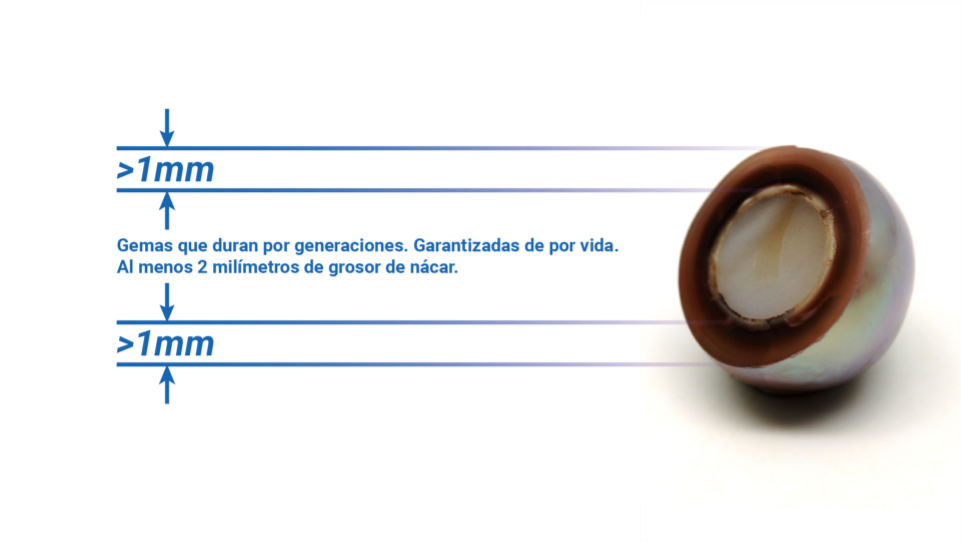
We feel are grateful for this year’s harvest especially with the resultant nacre thickness, which was excellent.  The range we consider typical of a Cortez Pearl is a minimum of 0.8 mm, with an average thickness of 1.2 mm and, in a rare occasions, exceeding 2.2 mm.  With this nacre thickness, Sea of Cortez pearls are just as good –and sometimes better- as most South Sea pearls in the market today.

In the image above you can appreciate the nacre thickness of a group of pearls that was cut in half to evaluate their nacreous coating. Those with a thinner coating (left side) have a thickness of 0.9 mm, the average ones (central portion) measure 1.5 mm and the thicker ones (on the right side) may even reach up to 2.8 mm (in all instances I am just mentioning the thickness on one of the pearl’s sides, as seen in the following photo).

Pearls in Half

Sea of Cortez pearls: Our guarantee

A case of Pearl Leprosy?

A thick nacre coating means that the pearl has what it takes to display good natural luster -thus it will not be necessary to polish it- and for the pearl to have durability -to endure the passage of time- and to become a family heirloom.  On the other hand a pearl with a thin nacre coating will seem dull and unappealing –unless the pearl is polished- lacking real beauty and devoid of orient, it will not be durable and can easily peel and crack.

The pearl we produce is guaranteed for life against natural defects if the pearl suffers any damage (not due to the wearer), then this pearl will be replaced by another one of the same quality for value. In most instances, any damage from the pearl is caused by the wearer such as scratches, damage caused by jewelers, and –sometimes-even being run over by a car, but these are exceptional cases.

If we take into consideration that a thinly coated pearl can have a “useful life” of only a few months to perhaps a couple of years, then a pearl with a value of $10.00 U.S. dollars becomes an expensive product:

  • $10.00 divided by 8 months = $1.25 per month
  • $10.00 divided by 24 months = 42¢ per month

But if the pearl has a thick nacre coating, then it has the potential of a long, useful life, well in the range of hundreds of years; but since this is something really hard to estimate, let us say that with a lifetime guarantee we are at least talking about 80 years. Thus if we have a pearl valued at $1,000 USD we are talking about a good price:

  • $1,000 divided by 80 years = $12.50 per year = $1.04 per month

So, you get the idea: quality pearls actually give you more of everything. And, now let us go back to our question of “why should we be interested in a pearl’s quality?” but now analyzing it from the viewpoint of the pearl producer: Why should we invest more time to in order to obtain a higher quality pearl?  What do we receive in exchange? The main thing you obtain is prestige to a proven quality and second: it’s a matter of personal pride (you can actually feel good about what you are doing).

Investing in quality is well worth it.  In the future, we will continue to talk about other aspects of pearl quality.

Identifying Pearls: The “Water Test”

Aug 6
Posted by admin Filed in Myths, Videos, pearl

Once more we have prepared a simple test that you can easily use to help you identify pearls. Some of these identification tests were used years ago to help identify a cultured pearl from a fake (faux) or imitation pearl. Even today this little test can help you to -indirectly- distinguish between different pearls, such as faux perles, freshwater pearls, Akoya pearls, black pearls and, of course, the Gulf of California pearls (also known as “Cortez Pearls“).

So for this test use another natural element but now opposite to the one used previously, now we use WATER. Unlike the “Fire Test” -which is very fun when used on fake pearls- the “Water Test” is not destructive, but it may have an aesthetic value when using it on the “appropriate” pearls. To understand what I’m talking about we first need to see some pictures and then talk about some arcane terms known by the names of “ORIENT” and “OVERTONES”.

Orient & Overtones on Pearls.

There  was much talk about a pearl’s “orient” some decades ago. If you read the discussions of many “connoisseurs”, they would usually talk about the unusual and beautiful appearance of a pearl’s “Orient” but for most of these “experts” it was difficult to explain -in an easily understood manner- this unique trait of pearls. So let us begin to demystify this beautiful visual attribute of pearls … first with the concept of Orient:

Orient:A remarkable phenomenon produced by light being reflected and refracted by the pearl layers, which produces an inner glow. The finer the pearl layer (aragonite crystal), the better the orient of the pearl. (Source)

Or this one as well, which actually confuses two different traits (luster and orient):

The Iridescence of pearls is called “luster” or “Orient”. Pearls show this glamorous play of colours in delicate nuances due to the bow in their surface, enabling us to perceive their brilliance from every angle. The interaction of light rays and surface creates the iridescence, the so called ‘surface colour’ visible as a small circle on the pearl’s outer layer of nacre. The luster depends on the thickness of nacre, numerous layers encasing the nucleus. The layers of nacre act like tiny prisms, refracting light, so it appears as all the colours of a rainbow. (Source)

Hard to understand? In both concepts we understand that “orient” is something really special and beautiful but it fails in giving us a clearer understanding. So, we will use the description -that in my opinion is the more colloquial and understandable- from the “Sea of Cortez Pearls” website:

“When this optical  effect manifests itself as a deep “halo effect” (mostly in the colors pink/violet and green/blue), the pearl may display as a series of concentric rings (with the color gradually changing to another one) that go from the pearl’s diameter and into the center. A pearl with such an effect will never be mistaken as a fake-pearl and it is highly coveted.”

A picture is worth a thousand words they say, so let us analyze one with different pearls: Freshwater pearls, faux perles (imitations), akoya pearls, black pearls and pearls from the Gulf of California:

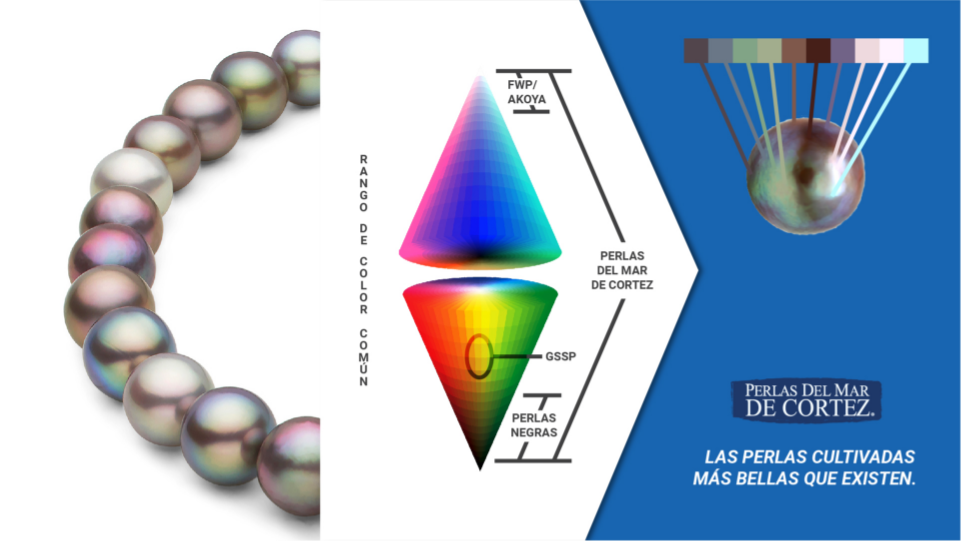
In these pictures we can see that both Black and Mexican pearls have a special sheen that makes it appear as if that they display various colors and that they do not display just one color…as seen on the other pearls. These “color rings” that seem to float on the pearl are known as “overtones” -when seen on dark colored pearls- and as “orient” on light colored pearls. At this time we will not talk about what causes this unique optical effect to manifest, but we will discuss this another time, but we will talk about using this visual attribute to differentiate pearls.

Water Test on Light Colored Pearls.

We used a small white colored plastic container and placed enough tap water into it to cover the pearls. We then moved to an area with good natural light (not necessarily under the sun), then introduced different pearls in the container. What happens? Water acts as an “visual amplifier” of this beautiful effect (orient/overtones) and, additionally, the white container helps to bounce light in an optimal way on the pearl: if the pearl does display orient or overtones then we will see a big difference . On the other hand, if a pearl does not exhibit this desirable effect… it is an imitation pearl -such as a Majorica/Shell-Pearl- or it could also be a real pearl that simply does not have what it takes to display this visual effect.

So here we have an example. We have a group of “white pearls” or light-colored pearls, including the following: a freshwater pearl, a “Mallorca Pearl”, another imitation known as a “Shell Pearl” and we also have a “Cortez Pearl”. Most of these pearls have a “normal pearl” look (“milky white”), except for Mexican pearls which display a beautiful green and pink orient.

Now, we introduce these same pearls in water and the change is significant: both the imitation pearls and the freshwater pearl had no change and are even “whiter”, but the pearls in the Gulf of California display a pair of color rings. Here we see the pearl’s orient easily:

Water Test on Dark Colored Pearls:

On the dark-colored pearls the results are more evident. Among the pearls used (a black pearl, a dyed-black freshwater pearl, a couple of fake pearls and one Mexican pearl) for this demonstration, several were capable of displaying a good visual effect of overtones. But now, let us see the contestants before being “water baptized”:

Now, let us look at the same pearl but inside water …

In the case of both the dyed pearl and the Tahitian black pearl, the overtones make a stronger appearance  than what can be seen on those same pearls with a naked eye. All three imitation pearls are devoid of overtones, but some would be confused with the “Shell Pearl” because in the photo you may see something similar to a ring, but it really is not … overtones are truly a dynamic visual effect that is best seen personally or in a video. Mexican pearls are noted for their overtones: a true visual spectacle.

Comparing light and dark pearls in Water:

This comparison allows you to see the differences between types of pearls. For example, dark pearls have a marked effect and light-colored pearls displayed no “orient”, perhaps because they were bleached and polished … as it is routinely done with these products.

From left to right: Akoya pearl, freshwater pearl, black pearl and dyed freshwater pearl

Imitation or Fake Pearls:

Imitation pearls do not display this desirable visual effect.

Pearls from the Sea of Cortez:

A rich visual delight … the colors have varied overtones with dynamic appearance, something rarely seen in other pearl varieties or only in Gem quality pearls. These “little things”, these “tiny details” are part of what makes this pearl so unique.

The Video.

And as in other occasions, I have prepared another video about this test because this is a visual and dynamic phenomenon. As with most of our videos, I once more used the “Sea of Cortez Pearl Theme” song, but I really wanted to use David Byrne’s “Strange Overtones ” song … but we all know about YouTube’s policies and I am not the one to argue about this, so I propose you use this link to play the song while you play the video and you can enjoy it in a different way.

By the way, the video shows other varieties of pearls not depicted on the blog, so you might find it interesting even if you have read this entire post.

Until the next installment …

Pearl Ruckus 2010 – Los Angeles, USA

Jul 30
Posted by admin Filed in Travels

I’ve just returned from a dizzying trip to the always impressive Californian metropolis, where I joined a select group of “Pearl-People” (people linked to the pearl industry) to discuss a subject that we always discuss: pearls,  pearls and more pearls. The interesting thing about such events is that they involve people who are in different areas of this field: pearl farmers, nuclei producers, wholesalers, retailers, designers, gemologists and collectors. In all: quite an interesting array of areas of expertise and depth of knowledge.

A total of 16 people were invited to the “Pearl Ruckus 2010″, an event that was promoted by Jeremy Shepherd, CEO of “Pearl Paradise“, by “Jewelmer” and by “Classical Wines of Spain”. The event included five conferences, as well as several social events where the pampered guests would enjoy fine Spanish wines, exquisite sushi and even indulge in a bit of Whiskey tasting. We were treated like royalty…and as such, pearls adorned all the fair ladies at the event.

Conferences – Saturday 24

Beginning at 10:30 am and ending at around 4 pm, we were fortunate to attend the presentations by the following lecturers:

Blaire Beavers (GemGeek): A comprehensive lecture on “Exotic Pearls”, among which Blair talked about the New Zealand’s Abalone Mabe pearls,  the large orange-colored “Melo-Melo” Conch pearls, the giant pearls of the Tridacna, the beautiful and elusive Nautilus pearls (a relative of “Paul the Octopus“) and, of course, the “Cortez Pearl”. I do have to point out that GemGeek recently visited our farm (last May),but she seemed fascinated by our local fare of regional seafood, and this was quite evident in the presentation, which included pictures of the fish tacos and other delicacies.

Michael Rivers (Mikeyy): Mike’s lecture gave us a very comprehensive, interesting and detailed description of the mother-of-pearl industry of the United States, from the early 20th century to the present; it included pearl mussel fishing methods, the production process of mother of pearl buttons and of the core of most cultured pearls: the little nacre bead. The talk ended with a discussion on the future of this industry.

Renné Newman: This renowned gemologist gave her presentation on the “Zhuji Pearl Market, China” and -much to our delight- she presented the 5th Edition of her famous book “The Pearl Buying Guide“. I must admit that we learned a lot about pearl quality by using the first edition (1992) of this book and that it made us very happy to see several new sections and photographs about our “Sea of Cortez Pearls” in this new edition.

Steve Metzler (smetzler): who has made an incredible effort towards the identification and certification of two types of extremely rare natural pearls: the pearls of the “giant clam” (Tridacna) and those of the cephalopod Nautilus. This research is carried out by specialists from Spain (Dr. Checa & Dr. Cartwright) and we cannot yet disclose information any about it … the information will be published within a few months. Steve’s collection of natural Tridacna and Nautilus pearls is simply unparalleled.

Douglas McLaurin (CortezPearls): Who, as always, was enjoying himself with his presentation about the “History of the Gulf of California Pearl”, with information ranging from the pre-columbian period to the present, including details of the pearl fisheries made by Spanish-Soldier-turned-Millionaire Manuel de Ocio, the farming methods of Don Gaston Vives and the short-lived farm of Don Manuel Lozano Gallo, then easing into the 1990′s research stage and, finally, the commercial aquaculture in Guaymas, Sonora.

Dinner:

What I can say I that I did not mentioned before? We had the most excellent hosts in Jeremy Shepherd and lovely Hisano Takei (who wore a beautiful kimono), we had Sushi chef Hitori Hirata preparing delicious sushi, the best caviar I’ve had, a fine selection of Spanish wines, including a delicious Galician Albariño wine, we had a “Scotch Whiskey Tasting event” with the help of Michael Udhe, and to wrap it all up: the excellent comradeship amongst the guests at this unique event.

I consider myself fortunate to have been invited this year and, God willing, there will be more Mexican Pearls at the 2011 Pearl Ruckus next year …

Announcing the “Bicentennial” Edition Pearl Necklace 2010

Jul 5

With great pleasure and satisfaction we announce the presentation of three pearl necklaces for the year 2010. As with all previous pearl necklaces that have been produced in Mexico since our pearl farm started operations, these necklaces are made using pearls from several crops or pearl-harvests; for these 3 necklaces, we have used pearls from the 2010, 2009, 2008 and even 2007 crops. You need extreme patience in order to produce a good string of pearls.

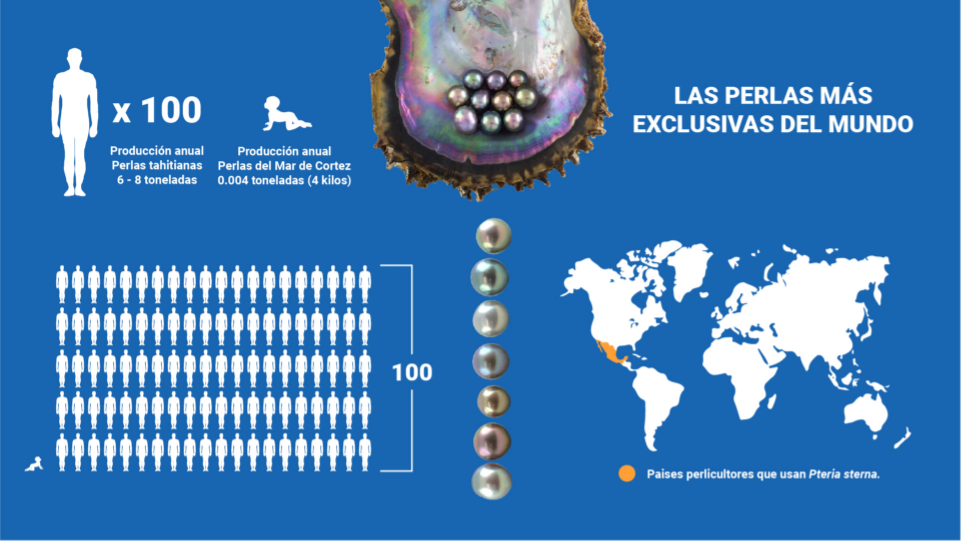
What makes these necklaces so special? Well, they consist of pearls produced in Mexico’s Gulf of California, a region known worldwide for its pearls, and these are cultured using a limited-production (4 kilos) scheme, these are the only cultured pearls that are produced under the “Fair Trade Gems” standards, the only cultured pearls that are produced using a “winged pearl oyster”: the “Rainbow-Lip Pearl Oyster“  or Pteria sterna, thus they are the rarest cultured pearls produced in the world and they also display a pink-red fluorescence under long wave UV rays, and are some of the very few cultured pearls that do not receive any “embellishing” treatments (physical nor chemical) … there are many more things to say about how special these pearls are, but this is just to lay the basics.

What we now need to do is present these three strings of pearls from the 2010 edition:

Necklace 2010 – A

This one consists of a graduated necklace with a length of 20″ (50.8 cm), made with 49 baroque pearls with a size (diameter) of between 8.0 and 8.7 mm, using “B” grade “Cortez Pearls” (“B” grade means that there are skin imperfections on the pearl and that its luster is not very high), the central pearl measure 8.7 x 9.1 mm . However, with its light gray color, unique shapes and its iridescent pearls makes it a truly exceptional piece. It has a simple yellow 18 K gold brooch.

Pearl Necklace 2010 – B

This is an excellent pearl necklace when you consider its price:benefit. It is a baroque pearl necklace, but these pearls are soft baroques (not by human action), in short, although these pearls are asymmetrical shaped they posses very soft shapes that are almost spherical in appearance, thus they look “round” from a certain distance. It is quite uncommon for our Gulf of California cultured pearls to have a perfectly round shape (the reasons will be explained in a future post), thus our spherical shapes attain a far greater value than that of the most common shape: the asymmetric or baroque shapes-so this necklace achieves a relative low cost with great looks or “more bang for your bucks”.

This graduated multicolored 19″ (48.26 cm) pearl necklace consists of 51 baroque pearls with a size between 8.0 & 8.6 mm (diameter) and made with “A” and “A+” grade pearls (this means very good natural luster and a clean pearl surface) of exceptional colors. The result is a rainbow-like necklace with red, green, blue gray, black and purple pearls … As with the previous necklace, it features a plain 18K yellow gold brooch.

Special Edition “Bicentennial” 2010 Pearl Necklace

This is a truly a unique Cortez Pearl necklace, a piece of jewelry fit for a Queen and truly something that very few can own. We’ve placed this necklace at the same level of delicacy -for want of a better word- as some of our finest necklaces such as “Stella Maris” (2009) and “Bohéme” (2008). The central pearl is a gorgeous purple pearl (11.6 mm) with incredible green overtones (obtained from the 2010 harvest).

This 19″ (48 cm) graduated multi-colored pearl necklace consists of 49 near-round Sea of Cortez Cultured Pearls with sizes between 8.7 and 11.6 mm (diameter),  and was made using the only “A+” and “Gem” grade pearls, featuring the most intensely colored pearls available, the highest natural luster and the best surface (“skin”) purity possible using only non-treated pearls. This necklace does not include a clasp, since the buyer usually acquires a specially made clasp for such a unique piece.

So far we have named this necklace as “Bicentennial” (Mexico turns 200 years old as an Independent country this year) but this name will be changed by the owner: in the purest pearling tradition these unique necklaces are named or are “christened” in the manner of other famous necklaces or Pearls of old. In today’s world, the vast majority of necklaces produced do not even deserve a nickname… but high quality pearls with a limited production are still worthy of this distinction.

Where are the other Cortez Pearl Necklaces?

Since our Bacochibampo Bay farm started producing loose cultured pearls in the year 2000, we have only managed to produce eight special pearl necklaces -with characteristics similar to those of the “Bicentennial” necklace- and we have always wanted for these to remain in Mexico, but this has not always been possible. So where are these necklaces? Here’s the list:

  • 3 necklaces in Mexico, including the three most perfect and beautiful: “Stella Maris”, “Bohéme” and “Balandra.”
  • 2 in the United States of America (“Maria” and “Isabella”)
  • 1 in Italy
  • 1 in New Zealand

Understandably, the owners remain anonymous. In the case of “Bohéme” it had the distinction of appearing in the book “Pearls” by gemologists Hubert Bari and David Lam, a book where the authors state (on page 86) the following about the “Sea of Cortez Pearl”: “It is perhaps the most beautiful pearl to have been cultured up to now” (Hubert Bari & David Lam. 2010. Pearls. Skira . Italy. 336 pages).

Where will the “Bicentennial” spend its Time? What will be its final name? That will be known soon …so, stay tuned!

Pearl Harvest 2010 – Natural Pearls

Jun 16
Posted by admin Filed in Harvest, Videos, pearl farm

Natural Pearls…this small phrase can mean different things depending on which portion of the food chain you are located in, so it can either mean utter nacreous ecstasy or feverish anger. Whatever your feelings are, every year we have the fortune of finding a few natural pearls within our farm-raised “Rainbow Lipped Pearl Oysters” (Pteria sterna). This quantity varies tremendously depending on environmental conditions (although some people have gone far to suggest that this depends solely on the actions and decisions taken by certain Political Party members…but no, it is certainly not the case) and the way these conditions become more propitious for the development of certain bio-elements (just a fancy word for “little water bugs”) that are normally found in our oceans.

For us, 2007 was an astounding year in Natural Pearl production, whereas 2008 & 2009 were not very productive in yield, but we did find a couple of very exceptional pearls (see “The Virgin’s Pearl” account of this same Blog). This year seems to be more similar to 2007 in pearl yield and quality.

So, before we proceed with the data from this year’s natural pearl harvest, let us watch a short video on natural pearl harvesting (taken from the 2007 natural pearl harvest):

If you paid close attention to the video, you will have noticed that all natural pearls were found inside a thin, semi-translucent membrane that was attached to the oyster’s mantle. This membrane is known as the “pearl sac” and it is where the pearl develops…in the same way a baby would develop inside a womb. A similar “pearl sac” is formed to produce a cultured pearl, but in this case the pearl sac develops inside the oyster’s gonad and due to Human intervention. Thus, when we find a natural pearl it is quite a surprise (similar to when you are told your wife is expecting twins…trust me on this), there is no Human intervention in their production. To notice the differences between the harvest of natural pearls (the video above) and that of cultured pearls you can now watch this other video:

Now that you have seen both videos you can realize how differently these pearls come to see the light of day or are “born unto the world”. Another significant difference between natural and cultured pearls is their size: most naturals we obtain are in a size range between 1 to 7 mm, whereas the smallest cultured pearls we obtain measure 8.3 mm in diameter. But perhaps the most striking difference would be quantity: you always obtain many more cultured pearls than natural pearls.

In a future post we will talk more in detail about how natural pearls are produced: their incidence, what causes them to appear (a grain of sand of course!!! sure…maybe it was a politician that came up with such an answer), but for the moment I just want to post some photos of some of this year’s natural pearls…let us begin!

This “cute” little natural pearl has quite some personality. Measuring 1 cm at its widest, it has the shape of a toon-like tortoise, complete with a little eye.

It is not the prettiest natural pearl we’ve harvested here, but it now belongs into a select group of “unconventional” pearls we’ve found, such as: doves, cats, hearts, aliens (pretty certain it was a so called “Gray“) and the “American Classic”: Mickey Mouse.

The next pearls are much more beautiful, but more “pearl shaped”, and by this I don’t mean “round”. Very few natural pearls we’ve harvested (out of hundreds in our 16+ years of work) have been perfectly round, and those that have this shape are usually very small (less than 2 mm).

Now we have a pair of “good sized” (7 mm diameter) baroque shaped natural pearls, slightly flattened (something quite normal in natural pearls). Their main color is dark so they would be considered “black pearls”…a term that I don’t particularly like because the Gulf of California Pearl is much more colorful. The one to the right has a red-wine coloration (probably Pinot Noir) and the one to the left has a  blue-green-violet coloration.

Now, we have a pair of pearl trios. The first one in sizes around 5 mm in diameter, but I believe they are even more beautiful than the larger ones: truly a case of “Bigger is not necessarily more Beautiful”. And the following trio (in sizes of 3 mm) are even more striking: some pearls even display the much coveted and desired “Fish Eye” effect.

These little pearls have very strong overtones, the one in the center having the most intense “fish eye” effect.

And to wrap it up for today…a beautiful pair of 8 mm natural pearls with very different colors: one is light gray with a strong violet overtone, the other one has a dark electric-blue coloration. One reason why pearls were known as “Unios” in the Latin language of Ancient Romans is because they were clearly unique, distinctive. These natural pearls are truly deserving of such name…but their Gulf of California Cultured Pearl counterparts are just as unique as their famous predecessor…you will not find any “Clonios” around here.

In our next edition: Cortez Keshi Pearls from the 2010 Harvest. See you next week!

Pearl Harvest 2010

Jun 11
Posted by admin Filed in Harvest, pearl farm

It is finally here…that special moment that takes place only once every year here at our Pearl Farm: the HARVEST. This year we expect to have a lower yield of pearls in comparison with last year’s, but we believe this harvest will be more beautiful than 2009′s.

All these pearls will be harvested from our Pearl Farm in Bacochibampo Bay, Guaymas, Sonora, México, in the central portion of the Gulf of California or Sea of Cortez. The pearls we produce are exclusively grown in one of our native pearl oysters: the “Rainbow Lipped Pearl Oyster” (Pteria sterna). I want to use this opportunity to clearly state that WE DO NOT PRODUCE pearls using the local “Black Lip Pearl Oyster” (Pinctada mazatlanica), because there are some “experts” that say we do, but we don’t. You can use a nifty UV light to see how our pearls glow pink-red, an attribute of pearls produced from the “Rainbow Lipped Oyster”.

Some interesting facts about this harvest is that we will -apparently- have softer and rounder shapes, with a very thick coating of nacre. As an example: we obtained a 13.7 mm (diameter) pearl, and we know -for sure- that the largest bead employed that day measured 9.5 mm in diameter…thus we know it has a 4.2 mm thick coating, or 2.1 mm per side which is what you would expect out of a good South Sea Pearl.

Colors this year seem to be more on the Lighter side…mostly light grays, but the colorful pearls are very colorful and intense, as you will notice on the photo below:

The next photo displays some of our light colored pearls, but when they have baroque shapes they will display very intense iridescence.

The intense colored pearls are coming out in stunning shapes and with great overtones…

Another one…

Finally, a selection of Gem+ grade pearls: great natural luster (our pearls are NEVER polished), excellent surface (clean, unblemished), intense colors and beautiful overtones…

Oval Hammered PearlAnd this great “Deep Purple” pearl, round, measuring 12 mm in diameter…this one will become the center piece for this year’s pearl necklace.

Finally, the pearl I came to Love from the minute it was plucked out: I christened it as “Matryoshka”, a most Slavic name for such a Mexican Pearl…but once you see its shape you understand why I named it this way. It has the most intense Aubergine color I have seen in years…

Will continue adding updates as the harvest proceeds…

Sea of Cortez Pearls – The Video

May 31

That’s right, we have already published on the web -thanks to YouTube- our Original video on “Sea of Cortez Pearls.” This was a project we had in mind for several years, but we never had the time to invest in an “original production”. The video reached a good compromise between what we wanted to play on the video, yet we could not achieve such as: we wanted a video clip of a hurricane in action on the pearl farm … but when this happens one usually take refuge in your home, or special clothing (we could not shoot a troop of  “Spanish Conquistadores” trudging through the desert) and,we were not able of getting a professional narrator (primarily due to time constraints) for the Spanish version of the video… but the English version has superb narration.

Despite being produced in 2008 (it achieved “Gold” status on December of that year) we had the video available only on DVD throughout 2009, and it was until this year that we decided to share it publicly.

The video is presented in two parts due to time constraints imposed by YouTube. The first part is a presentation of the Gulf of California Pearl:its lore and History; the second part deals with the commercial cultivation of pearls in Guaymas, Sonora. So, with no more hesitation: we hope you enjoy the video…

We thank all those who participated directly in this beautiful project, specially the staff of “Cheque’s Films” from our good friends Ezekiel “el Cheque” Núñez and Esteban Ibarra (who were in charge of cameras and video editing), the original “Perlas del Mar de Cortez Soundtrack” was the work of  Jaime Delgado Avelar,the  excellent voice narration by the professional narrator Charlie Bloomer, and photos taken by another good friend, Alberto “el Gordo”  Tirado. Another couple of good video details provided by our friend Benito Sarmiento (thank you for allowing us to use your videocam and “casing” as well as for lending us your aerial video of Bacochibampo Bay), and finally, the great 3-D work of the “Spanish Galleon” done by Abraham Castro of “Onix” fame. In all, this video was made 100% in Guaymas, Sonora.

The script for the video was produced by us (“pearl trio”), in addition to video footage and photos that we did and incorporated into this video.

Additional thanks? Sure! There are many people who we would like to give special thanks, and amongst them we have:
“The Yaqui Diver”/Adrian Amarillas Casillas, our friends Rocio Mendoza and Diana Alvarez, as well as to  Karla Valdez, Sergio Farell -our friend and former mentor- the ” Tec de Monterrey” for showing faith in our school project and, of course, our group of  “Yaqui Workers” led by Jesus “el Pipi” Valenzuela.

I invite you to please leave your comments … I know that in order to leave a comment you are required to use an e-mail account, but for those who do not want to leave a comment because you will “need” to use your e-mail, you can do the following: there is no need to enter a real email … instead use this fake e-mail chachalaca@chachalaca.com.mx (“copy & paste” and place in the appropriate field) and you will see that it is not necessary to use your personal mail.

See you next week!

“Pearls: A Natural History” back from NYC

Apr 20
Posted by admin Filed in Museum, Sea of Cortez, Travels, pearl

Well, it took a few years for our Cortez Pearls to arrive back to our farm in Guaymas, but they did arrive safely and -most importantly- with the experience of “seasoned travellers”. The pearls were all produced using our native “Rainbow Lipped Pearl Oyster” (Pteria sterna)… a very special creature capable of producing the most varied colors and overtones.

This was the lucky group of cultured pearls from the 2000 harvest consisting of:

  • 4 loose pearls (sizes from 9 to 10 mm)
  • 8 Mabe pearls (in different shapes: from “classic” -hemispherical- to blister-drops)
  • 12 Keshi pearls (sizes from 5 to 8 mm)

The pearls were destined for the “Pearls: A Natural History” museum display at New York City’s “American Museum of Natural History” (AMNH). This was an incredibly successful exhibit that opened on October 13th, 2001, and closed on April 14th of 2002… but after this date it went on a “Grand World Tour” to cities like Chicago, Paris, London, Tokyo and Sidney. The Museum produced a book aptly named “Pearls: A Natural History” under the authorship of Neil H. Landman & Paula M. Mikkelsen (a splendid book with very nice photographs) that covers the most important aspects that surround our favorite organic gem: history, lore & culture, biology of the creatures that produce pearls and even its gemological attributes. One of my favorite pearl books written in this Century.

The only thing I did not like much about the book is that our pearls are not prominently featured… wish I had a better digital camera those days (had a very good Sony Mavica with 640 x 480 resolution)… guess the book needed better photos. Mea culpa!

Anyway… the pearls are back home -but no longer as naive but as more experienced pearls- and will reside inside a special display case at our “Customer Attention Center” in Guaymas so they will continue to greet our visitors in all the languages they learned. So, when in Guaymas… come say “Hello” to our beautiful traveling pearls…

Cultured Cortez Pearls

Alejandra Solomon & the Sea of Cortez Pearl

Apr 20
Posted by admin Filed in Jewelry Designers, Sea of Cortez

Our friend, the talented jewelry designer, Alejandra Solomon has done it again. In 2009 she obtained a very important place with her jewelry designs at the AGTA Spectrum Awards, but this year (2010) she earned a most excellent prize in that same contest, winning first place on earrings design.


And today I find out that her jewelry, which always uses the finest gems -such as Sea of Cortez Pearls and Mexican fire opal- appeared inside “Inside Wedding” magazine, published on her own stomping grounds: the “Big Apple”. So this is yet another great success for Alejandra in her recent career as a freelance modern jewelry designer.

Alejandra is one of those special people with whom you feel perfectly at ease and as if you have known her all your life… although we only meet just a couple of times a year (New York and Guaymas are somewhat distant from each other). She will visit with her mother -our beloved Ana Maria Wilson- whenever they can and especially during the pearl harvest season, because they really like to hand-pick the most unusual and colorful cultured pearls… and our fanciest precious little pearls: Cortez Keshi.
Alejandra: I congratulate you most sincerely for your string of successes and producing such beautiful jewelry.

For those wishing to know more about this great new designer (I do have to mention she has the loveliest green eyes I’ve seen … after my wife Elizabeth’s eyes, of course) you can visit their website and also view her designs in our e-Store.
Alejandra, Ana María and Enrique during Pearl Harvest
By the way …did you notice the value of the earrings on “Inside Wedding”??? Well worth it…

Cortez Pearls Exhibited in Doha, Qatar

Feb 12
Posted by admin Filed in Travels

I believe that throughout the years we have been able to rely on the helping hands of many people in order to continue our journey trough uncharted waters. Yes, we have been fortunate enough to have found more friendly faces on our path than sour and dour ones, but this is not the Time -although it is indeed a good place- to Thank everyone that has made it possible for us to survive in this exceedingly difficult task of “reviving” the Legend of the Sea of Cortez Pearl, but rest be assured: we will give proper thanks to everyone. Now, since this is a very recent event we do owe a BIG THANK YOU to Monsieur Hubert Bari (French Gemologist and Curator of the Pearl Exhibit at Doha, Qatar), for his invitation to join him at Doha’s Museum of Islamic Art for his “Pearls” exhibit. Our “Sea of Cortez Pearls” are now part of  a very exclusive group of pearls (including many fantastic pieces of pearl jewelry and rare natural pearls), amongst which the visitor may admire the following:

  • 5 “AA” grade Cortez Mabe Pearls
  • 5 Natural Pearls (measuring 4-7 mm)
  • 10 “Gem Quality” Cortez Cultured Pearls (9-11 mm)
  • 1 blue colored Cortez Pearl Ring, set in an 18K Gold & Fair Trade Diamonds design by TriGem Designs.

Enrique Arizmendi, our General Director, traveled to Doha to be at the inauguration of the Museum Exhibit and also for another grand event: the presentation of Monsieur Bari’s and David Lam’s new “Pearls” book (to be sold at stores this summer). The book is surely to become the most sought-after reference book  in all Pearldom: its information is both detailed and scientifically precise, but written in layman’s language. It also has some of the most beautiful photos of pearls, paintings and pearling I have ever seen in one single book, the diagrams are crisp and detailed. A masterpiece with over 330 pages and 3 kilos in weight. A most serious contender for Elisabeth’s Strack’s “Perlen” book.

This superb book includes a special chapter called “Gentlemen Farmers” that includes a more detailed explanation on the operation of several important pearling ventures such as: Japan’s “Mikimoto Pearls”, Indonesia’s “Atlas South Sea Pearls”, the Philippines’ “Jewelmer” and Mexico’s “Perlas del Mar de Cortez”. The book points out how our operation is the only one in the world that has been able to utilize a Pteria genus pearl oyster (as opposed to the Pinctada species employed by all other salt-water pearl farmers).

Also, I wanted to also thank our photographer friends Paco de la Rosa of Cancún and Alberto Tirado of Guaymas for the excellent photos they took and that now embellish this incredible book. Kudos!!!