Making a small stop in our discussion about methodologies to identify between fake/imitation pearls and genuine pearls, we’re going into a more “historic mood”. We recently had a lively discussion with some friends about the name of our beautiful sea: the world-famous “Gulf of California” or “Sea of Cortez”.” Thus, we believed that this information would also be of interest to others who enjoy a more historical theme and because this year -2010- we celebrate the Mexico’s Bicentennial, which makes it all the more appropriate. If you want to be part of this debate, do take some time to place your comments.
Where do we get the name of “Sea of Cortez”?
The answer is almost obvious, although there are those who want to “forget” that Mexico is a country that resulted from being conquered by Spain about 500 years ago. This conquest was military and cultural, and gave origin to the country we now know as “Mexico” (although it is officially called “Estados Unidos Mexicanos” or “United Mexican States”) and the reason to why the official language is “Spanish” (or “Castillian”), the dominant religion is Roman Catholic and our “race” (or “races” some would say) and culture, including our renowned cuisine, is of “mixed-ancestry”: a multi-regional fusion of races and cultures. The name of “Sea of Cortez” then, pays honor to the Conqueror of Mexico, Don Hernán Cortés, a man very much interested in expanding the borders of the Kingdom of new Spain and exploit its newfound wealth, including its “black pearls”.
“Official” versus “Popular” Names
Now, the debate arose because some feel that this name – “Sea of Cortez” – is not official and therefore must not be used or even be “remembered”, that it should be “wiped out” into oblivion. Our answer would be the following: we (Mexicans) have an Official Country Name: “Estados Unidos Mexicanos” which is used before international organizations (such as: the United Nations (UN), UNEP, FAO, OAS, etc.) and even in a few federal institutions (such as INEGI), but we also have a common use or “Popular Name“, the latter being the one in the heart-and-minds of the common folk. Popular names are the ones meant to be savoured when used.
For us, it really would be the same case as in the use of “Mexico” and “Sea of Cortez”. There is really no reason to exclude one name over the other… both name can be used and they are in no way mutually exclusive. Thus it is almost impossible to imagine celebrating one of our National Holidays (such as “16 de Septiembre” or “20 de Noviembre”) to the cry of “¡Vivan los Estados Unidos Mexicanos!” (“Long Live the United Mexican States!”) instead of the most widely used “Viva Mexico!” (“Long Live Mexico!”).
Verifying the name of “Sea of Cortez”
This was the most heated debate point because it should focus on historical references on the use of the name of this area, and there are many references to varied names used by a large number of historical figures who visited this region during its exploration. Amongst these different names, we find some that specifically point to certain areas within the Gulf of California and do not make reference to this geographical area in general (the Gulf). Just to mention a few: “California” (which refers to the peninsula with the same name), “Calafia” (in reference to a mythical Queen of the exploits of “The Sergas de Esplandián“) and even other less popular as “Sea of Anian” (in reference to a mythical “ Strait of Anian“) and “Island of Pearls” (a very popular name for many great pearl producing areas). Under this frame of mind, another very appropriate name should also be that of “Sea of Seas” (using as reference the name of “Port of Ports” given to the Bay of Guaymas by Francisco de Ulloa in 1539). Which of these –then- is the most appropriate reference?
The answer cannot come neither from myths or tales… these were all necessary to inspire the “Conquistadors” unto action, but our references should have greater solidity. Who in New Spain had the skills to write down and record important events and references? Would the Spanish “soldadesca” (grunt soldiers) have these abilities? Probably the most robust and strong references would be found within religious missionaries (mainly Jesuits) and the public notaries that accompanied the conquering armies of Spain.
We therefore present an indisputable historical reference: a document written by the Jesuit priest Miguel Venegas, originally written in 1739 (although published in Madrid until the year 1752). This manuscript consists of 5 volumes and is entitled “News of the California and their temporal and spiritual conquest to the present time” and in volume 1 it records the following reference to this geographical area in general:
“The old discoverers called it “Vermillion Sea” and “Red Sea” because of the similarity of its figure and some color or appearance of its waters… they named it also “Sea of Cortez” in gracing the commitment with which the Conqueror of the Mexican Empire sought to advance through the glories of his conquests”
Thus we have reliable evidence on the name of this beautiful Mexican sea: “Vermillion Sea” or “Sea of Cortez”, and we can avoid any review of cartographic maps made by Europeans who –very likely- never visited this region (as it would be the case of Frederick de Wit, a famous Dutch cartographer who made the famous map indicating the mythical “Strait of Anian”).
Conclusions
You can use both names to suit your taste or preference, if you are doing any sort of “official work”, then by all means employ the name of “Gulf of California”, but you may use the name “Sea of Cortez” to your heart’s content, especially when you feel your heart’s beat increase when you contemplate a majestic sunset in Bacochibampo Bay, Guaymas, or when you enjoy a leisure stroll on the beautiful waterfront of La Paz, or when you gaze at the mystic beauty of Mexico’s largest Island: “Isla Tiburón” or when you simply enjoy a refreshing dip in “Rocky Point” (Puerto Peñasco)… no matter what part of the Gulf you’re in, you will always find a place for the “Sea of Cortez” within your heart.
Additional Note: We were also questioned about our pearls’ trade-name: why did we call them “Sea of Cortez Pearls”??? The answer: it was important for us that every single one of our pearls to have their historic legacy in their name; just as a child receives a name from its parents.
For us it was simply not dignified to brand them under a typical commercial name (they actually could have ended with a name like “Perliva“… a “Pearly Diva”) like any other mass manufactured product. We believe in our Pearl and we regard it as a true heir to the pearling heritage of Mexico, and we are proud to be able to produce limited quantities of these beautiful gems in Guaymas, Sonora, right in the heart of the Sea of Cortez…
I now invite you to make a small -5 minute- video- about the history of the “Sea of Cortez Pearl”… until next time…
With great pleasure and satisfaction we announce the presentation of three pearl necklaces for the year 2010. As with all previous pearl necklaces that have been produced in Mexico since our pearl farm started operations, these necklaces are made using pearls from several crops or pearl-harvests; for these 3 necklaces, we have used pearls from the 2010, 2009, 2008 and even 2007 crops. You need extreme patience in order to produce a good string of pearls.
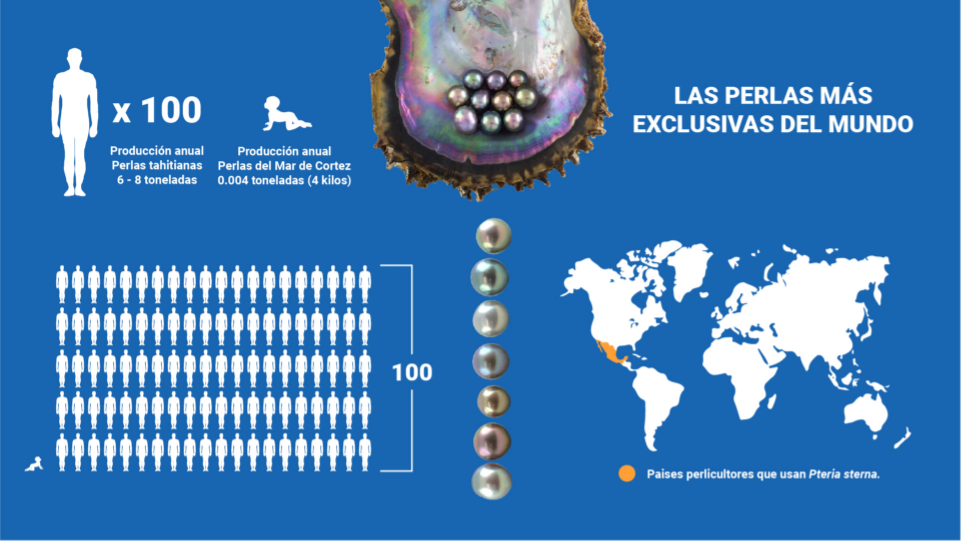
What makes these necklaces so special? Well, they consist of pearls produced in Mexico’s Gulf of California, a region known worldwide for its pearls, and these are cultured using a limited-production (4 kilos) scheme, these are the only cultured pearls that are produced under the “Fair Trade Gems” standards, the only cultured pearls that are produced using a “winged pearl oyster”: the “Rainbow-Lip Pearl Oyster“ or Pteria sterna, thus they are the rarest cultured pearls produced in the world and they also display a pink-red fluorescence under long wave UV rays, and are some of the very few cultured pearls that do not receive any “embellishing” treatments (physical nor chemical) … there are many more things to say about how special these pearls are, but this is just to lay the basics.
What we now need to do is present these three strings of pearls from the 2010 edition:
Necklace 2010 – A
This one consists of a graduated necklace with a length of 20″ (50.8 cm), made with 49 baroque pearls with a size (diameter) of between 8.0 and 8.7 mm, using “B” grade “Cortez Pearls” (“B” grade means that there are skin imperfections on the pearl and that its luster is not very high), the central pearl measure 8.7 x 9.1 mm . However, with its light gray color, unique shapes and its iridescent pearls makes it a truly exceptional piece. It has a simple yellow 18 K gold brooch.
This is an excellent pearl necklace when you consider its price:benefit. It is a baroque pearl necklace, but these pearls are soft baroques (not by human action), in short, although these pearls are asymmetrical shaped they posses very soft shapes that are almost spherical in appearance, thus they look “round” from a certain distance. It is quite uncommon for our Gulf of California cultured pearls to have a perfectly round shape (the reasons will be explained in a future post), thus our spherical shapes attain a far greater value than that of the most common shape: the asymmetric or baroque shapes-so this necklace achieves a relative low cost with great looks or “more bang for your bucks”.
This graduated multicolored 19″ (48.26 cm) pearl necklace consists of 51 baroque pearls with a size between 8.0 & 8.6 mm (diameter) and made with “A” and “A+” grade pearls (this means very good natural luster and a clean pearl surface) of exceptional colors. The result is a rainbow-like necklace with red, green, blue gray, black and purple pearls … As with the previous necklace, it features a plain 18K yellow gold brooch.
Special Edition “Bicentennial” 2010 Pearl Necklace
This is a truly a unique Cortez Pearl necklace, a piece of jewelry fit for a Queen and truly something that very few can own. We’ve placed this necklace at the same level of delicacy -for want of a better word- as some of our finest necklaces such as “Stella Maris” (2009) and “Bohéme” (2008). The central pearl is a gorgeous purple pearl (11.6 mm) with incredible green overtones (obtained from the 2010 harvest).
This 19″ (48 cm) graduated multi-colored pearl necklace consists of 49 near-round Sea of Cortez Cultured Pearls with sizes between 8.7 and 11.6 mm (diameter), and was made using the only “A+” and “Gem” grade pearls, featuring the most intensely colored pearls available, the highest natural luster and the best surface (“skin”) purity possible using only non-treated pearls. This necklace does not include a clasp, since the buyer usually acquires a specially made clasp for such a unique piece.
So far we have named this necklace as “Bicentennial” (Mexico turns 200 years old as an Independent country this year) but this name will be changed by the owner: in the purest pearling tradition these unique necklaces are named or are “christened” in the manner of other famous necklaces or Pearls of old. In today’s world, the vast majority of necklaces produced do not even deserve a nickname… but high quality pearls with a limited production are still worthy of this distinction.
Where are the other Cortez Pearl Necklaces?
Since our Bacochibampo Bay farm started producing loose cultured pearls in the year 2000, we have only managed to produce eight special pearl necklaces -with characteristics similar to those of the “Bicentennial” necklace- and we have always wanted for these to remain in Mexico, but this has not always been possible. So where are these necklaces? Here’s the list:
- 3 necklaces in Mexico, including the three most perfect and beautiful: “Stella Maris”, “Bohéme” and “Balandra.”
- 2 in the United States of America (“Maria” and “Isabella”)
- 1 in Italy
- 1 in New Zealand
Understandably, the owners remain anonymous. In the case of “Bohéme” it had the distinction of appearing in the book “Pearls” by gemologists Hubert Bari and David Lam, a book where the authors state (on page 86) the following about the “Sea of Cortez Pearl”: “It is perhaps the most beautiful pearl to have been cultured up to now” (Hubert Bari & David Lam. 2010. Pearls. Skira . Italy. 336 pages).
Where will the “Bicentennial” spend its Time? What will be its final name? That will be known soon …so, stay tuned!
Natural Pearls…this small phrase can mean different things depending on which portion of the food chain you are located in, so it can either mean utter nacreous ecstasy or feverish anger. Whatever your feelings are, every year we have the fortune of finding a few natural pearls within our farm-raised “Rainbow Lipped Pearl Oysters” (Pteria sterna). This quantity varies tremendously depending on environmental conditions (although some people have gone far to suggest that this depends solely on the actions and decisions taken by certain Political Party members…but no, it is certainly not the case) and the way these conditions become more propitious for the development of certain bio-elements (just a fancy word for “little water bugs”) that are normally found in our oceans.
For us, 2007 was an astounding year in Natural Pearl production, whereas 2008 & 2009 were not very productive in yield, but we did find a couple of very exceptional pearls (see “The Virgin’s Pearl” account of this same Blog). This year seems to be more similar to 2007 in pearl yield and quality.
So, before we proceed with the data from this year’s natural pearl harvest, let us watch a short video on natural pearl harvesting (taken from the 2007 natural pearl harvest):
If you paid close attention to the video, you will have noticed that all natural pearls were found inside a thin, semi-translucent membrane that was attached to the oyster’s mantle. This membrane is known as the “pearl sac” and it is where the pearl develops…in the same way a baby would develop inside a womb. A similar “pearl sac” is formed to produce a cultured pearl, but in this case the pearl sac develops inside the oyster’s gonad and due to Human intervention. Thus, when we find a natural pearl it is quite a surprise (similar to when you are told your wife is expecting twins…trust me on this), there is no Human intervention in their production. To notice the differences between the harvest of natural pearls (the video above) and that of cultured pearls you can now watch this other video:
Now that you have seen both videos you can realize how differently these pearls come to see the light of day or are “born unto the world”. Another significant difference between natural and cultured pearls is their size: most naturals we obtain are in a size range between 1 to 7 mm, whereas the smallest cultured pearls we obtain measure 8.3 mm in diameter. But perhaps the most striking difference would be quantity: you always obtain many more cultured pearls than natural pearls.
In a future post we will talk more in detail about how natural pearls are produced: their incidence, what causes them to appear (a grain of sand of course!!! sure…maybe it was a politician that came up with such an answer), but for the moment I just want to post some photos of some of this year’s natural pearls…let us begin!
This “cute” little natural pearl has quite some personality. Measuring 1 cm at its widest, it has the shape of a toon-like tortoise, complete with a little eye.
It is not the prettiest natural pearl we’ve harvested here, but it now belongs into a select group of “unconventional” pearls we’ve found, such as: doves, cats, hearts, aliens (pretty certain it was a so called “Gray“) and the “American Classic”: Mickey Mouse.
The next pearls are much more beautiful, but more “pearl shaped”, and by this I don’t mean “round”. Very few natural pearls we’ve harvested (out of hundreds in our 16+ years of work) have been perfectly round, and those that have this shape are usually very small (less than 2 mm).
Now we have a pair of “good sized” (7 mm diameter) baroque shaped natural pearls, slightly flattened (something quite normal in natural pearls). Their main color is dark so they would be considered “black pearls”…a term that I don’t particularly like because the Gulf of California Pearl is much more colorful. The one to the right has a red-wine coloration (probably Pinot Noir) and the one to the left has a blue-green-violet coloration.
Now, we have a pair of pearl trios. The first one in sizes around 5 mm in diameter, but I believe they are even more beautiful than the larger ones: truly a case of “Bigger is not necessarily more Beautiful”. And the following trio (in sizes of 3 mm) are even more striking: some pearls even display the much coveted and desired “Fish Eye” effect.
These little pearls have very strong overtones, the one in the center having the most intense “fish eye” effect.
And to wrap it up for today…a beautiful pair of 8 mm natural pearls with very different colors: one is light gray with a strong violet overtone, the other one has a dark electric-blue coloration. One reason why pearls were known as “Unios” in the Latin language of Ancient Romans is because they were clearly unique, distinctive. These natural pearls are truly deserving of such name…but their Gulf of California Cultured Pearl counterparts are just as unique as their famous predecessor…you will not find any “Clonios” around here.
In our next edition: Cortez Keshi Pearls from the 2010 Harvest. See you next week!
It is finally here…that special moment that takes place only once every year here at our Pearl Farm: the HARVEST. This year we expect to have a lower yield of pearls in comparison with last year’s, but we believe this harvest will be more beautiful than 2009′s.
All these pearls will be harvested from our Pearl Farm in Bacochibampo Bay, Guaymas, Sonora, México, in the central portion of the Gulf of California or Sea of Cortez. The pearls we produce are exclusively grown in one of our native pearl oysters: the “Rainbow Lipped Pearl Oyster” (Pteria sterna). I want to use this opportunity to clearly state that WE DO NOT PRODUCE pearls using the local “Black Lip Pearl Oyster” (Pinctada mazatlanica), because there are some “experts” that say we do, but we don’t. You can use a nifty UV light to see how our pearls glow pink-red, an attribute of pearls produced from the “Rainbow Lipped Oyster”.
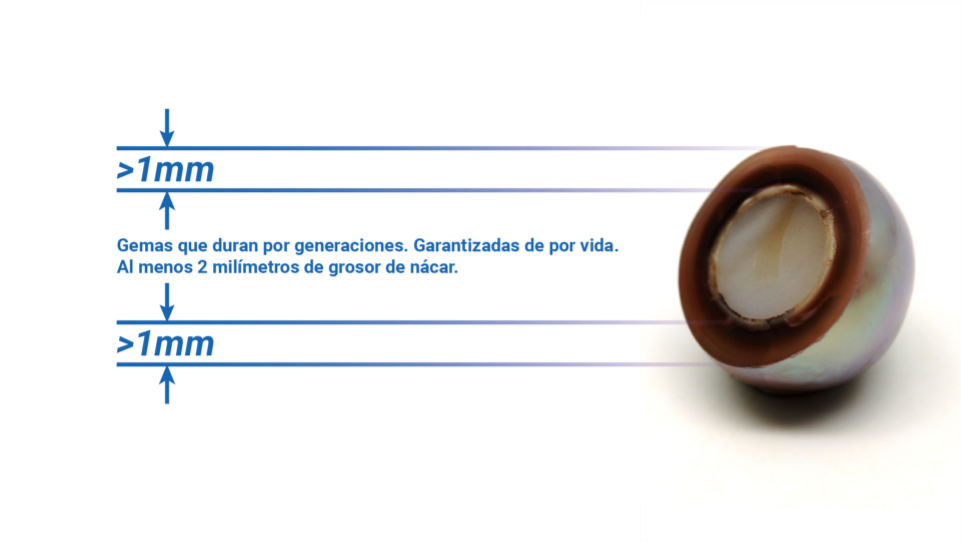
Some interesting facts about this harvest is that we will -apparently- have softer and rounder shapes, with a very thick coating of nacre. As an example: we obtained a 13.7 mm (diameter) pearl, and we know -for sure- that the largest bead employed that day measured 9.5 mm in diameter…thus we know it has a 4.2 mm thick coating, or 2.1 mm per side which is what you would expect out of a good South Sea Pearl.
Colors this year seem to be more on the Lighter side…mostly light grays, but the colorful pearls are very colorful and intense, as you will notice on the photo below:
The next photo displays some of our light colored pearls, but when they have baroque shapes they will display very intense iridescence.
The intense colored pearls are coming out in stunning shapes and with great overtones…
Another one…
Finally, a selection of Gem+ grade pearls: great natural luster (our pearls are NEVER polished), excellent surface (clean, unblemished), intense colors and beautiful overtones…

And this great “Deep Purple” pearl, round, measuring 12 mm in diameter…this one will become the center piece for this year’s pearl necklace.
Finally, the pearl I came to Love from the minute it was plucked out: I christened it as “Matryoshka”, a most Slavic name for such a Mexican Pearl…but once you see its shape you understand why I named it this way. It has the most intense Aubergine color I have seen in years…
Will continue adding updates as the harvest proceeds…
That’s right, we have already published on the web -thanks to YouTube- our Original video on “Sea of Cortez Pearls.” This was a project we had in mind for several years, but we never had the time to invest in an “original production”. The video reached a good compromise between what we wanted to play on the video, yet we could not achieve such as: we wanted a video clip of a hurricane in action on the pearl farm … but when this happens one usually take refuge in your home, or special clothing (we could not shoot a troop of “Spanish Conquistadores” trudging through the desert) and,we were not able of getting a professional narrator (primarily due to time constraints) for the Spanish version of the video… but the English version has superb narration.
Despite being produced in 2008 (it achieved “Gold” status on December of that year) we had the video available only on DVD throughout 2009, and it was until this year that we decided to share it publicly.
The video is presented in two parts due to time constraints imposed by YouTube. The first part is a presentation of the Gulf of California Pearl:its lore and History; the second part deals with the commercial cultivation of pearls in Guaymas, Sonora. So, with no more hesitation: we hope you enjoy the video…
We thank all those who participated directly in this beautiful project, specially the staff of “Cheque’s Films” from our good friends Ezekiel “el Cheque” Núñez and Esteban Ibarra (who were in charge of cameras and video editing), the original “Perlas del Mar de Cortez Soundtrack” was the work of Jaime Delgado Avelar,the excellent voice narration by the professional narrator Charlie Bloomer, and photos taken by another good friend, Alberto “el Gordo” Tirado. Another couple of good video details provided by our friend Benito Sarmiento (thank you for allowing us to use your videocam and “casing” as well as for lending us your aerial video of Bacochibampo Bay), and finally, the great 3-D work of the “Spanish Galleon” done by Abraham Castro of “Onix” fame. In all, this video was made 100% in Guaymas, Sonora.
The script for the video was produced by us (“pearl trio”), in addition to video footage and photos that we did and incorporated into this video.
Additional thanks? Sure! There are many people who we would like to give special thanks, and amongst them we have:
“The Yaqui Diver”/Adrian Amarillas Casillas, our friends Rocio Mendoza and Diana Alvarez, as well as to Karla Valdez, Sergio Farell -our friend and former mentor- the ” Tec de Monterrey” for showing faith in our school project and, of course, our group of “Yaqui Workers” led by Jesus “el Pipi” Valenzuela.
I invite you to please leave your comments … I know that in order to leave a comment you are required to use an e-mail account, but for those who do not want to leave a comment because you will “need” to use your e-mail, you can do the following: there is no need to enter a real email … instead use this fake e-mail chachalaca@chachalaca.com.mx (“copy & paste” and place in the appropriate field) and you will see that it is not necessary to use your personal mail.
See you next week!
Our friend, the talented jewelry designer, Alejandra Solomon has done it again. In 2009 she obtained a very important place with her jewelry designs at the AGTA Spectrum Awards, but this year (2010) she earned a most excellent prize in that same contest, winning first place on earrings design.

And today I find out that her jewelry, which always uses the finest gems -such as Sea of Cortez Pearls and Mexican fire opal- appeared inside “Inside Wedding” magazine, published on her own stomping grounds: the “Big Apple”. So this is yet another great success for Alejandra in her recent career as a freelance modern jewelry designer.
Alejandra is one of those special people with whom you feel perfectly at ease and as if you have known her all your life… although we only meet just a couple of times a year (New York and Guaymas are somewhat distant from each other). She will visit with her mother -our beloved Ana Maria Wilson- whenever they can and especially during the pearl harvest season, because they really like to hand-pick the most unusual and colorful cultured pearls… and our fanciest precious little pearls: Cortez Keshi.
Alejandra: I congratulate you most sincerely for your string of successes and producing such beautiful jewelry.
For those wishing to know more about this great new designer (I do have to mention she has the loveliest green eyes I’ve seen … after my wife Elizabeth’s eyes, of course) you can visit their website and also view her designs in our e-Store.
![Ana María y Alexandra en cosecha (2) [640x480] Alejandra, Ana María and Enrique during Pearl Harvest](http://www.perlas.com.mx/blog/wp-content/uploads/2010/04/Ana-María-y-Alexandra-en-cosecha-2-640x480.jpg)
By the way …did you notice the value of the earrings on “Inside Wedding”??? Well worth it…
Well now, 2010 has finally arrived…this year at least promises much more “excitement” than last year. We do wish you all a great new year… and I hope we’ll have more time on our hands to write down many more stories that we’ve had the intention of sharing, but in the meantime an update on the “Virgin’s Pearl”:
1) On December 18th, 2009, we found another Natural Pearl. Yep! And this one was the ONLY natural pearl we were able of harvesting from our farm-raised Rainbow Lipped Oysters (Pteria sterna). We caught the moment on video and have shared it on YouTube.
Once more, just like in 2008 and in the same day: the Day of the Virgin of the Solitude of Oaxaca. This pearl measures 8.5 x 8.7 mm (diameter), and weighs in at 0.9 grams. Not exactly a huge pearl, nor was it perfect…but there is too much a coincidence there.
2) The Virgin’s new gold & gem studded attire is almost ready for her new “coronation”. Our friends from Oaxaca were kind enough to send us some photos of our pearl (have to get used to say “Her Pearl”) on its brand new gold setting. It looks very nice…an excellent job!
And we keep going back in time, delving into our memory to bring you the emotional experiences of being “real pearl farmers”: and by this I mean that we are entirely detached from the “glam” associated with this beautiful pearl we produce. Once more then, we begin this chapter by reviewing another hurricane that carved itself unto our memory and souls: “Hurricane Marty” – the deadliest hurricane of 2003 (death toll: 12 people).
On September 2003, a tropical storm named “Marty” was born in front of Mexico’s Pacific coast (near Jalisco) and as it feed off the warmer waters it began growing until we had a Scale 2 hurricane near the Cabo area in the Baja’s tip. This is certainly not a “terrible” scale for a hurricane, but in this case it was more a matter of technique over size…it was more than capable of causing serious destruction in 4 Mexican States (Baja California, Baja California Sur, Sonora & Sinaloa), some 12 deaths and the destruction of 80% of our pearl farm’s rainbow-lipped oysters. This hurricane is a dividing moment for Mexican Pearl Farming.
On this occasion, the hurricane’s effects were supposed to arrive in a deteriorated state to our locality (Guaymas): the hurricane touched land on the Cabo region, then visited La Paz and became -once more- a mere “tropical storm” when it entered the Gulf of California and began snaking its way upwards into the Colorado River’s mouth. The hurricane’s short lived time frame (September 21-26) gave it time enough to cause havoc in many small cities and towns like Los Mochis, Navojoa, Guaymas, La Paz, Mulegé, Loreto and San Felipe. Somehow the storm’s path inside the Sea of Cortez created a “channel of destruction”: encased between the “Sierra de la Giganta” on the left and the coastline of Sonora to the right. Thus, the rainfall, winds and waves became amplified throughout the area.
Bacochibampo Bay has been -traditionally- safe haven from the negative effects of storms and hurricanes. The reason for it is the way its “mouth” opens to the greater Bay or “Ensenada de San Francisco”: slightly northward, with a curve to the left. This is great help because most storms approach the area from the south, and a good assortment of hills surround the bay as well, thus offering ample protection. But this was not enough for this tricky hurricane because it snaked upwards and was -eventually- north of our position and its effects radiated downwards and then we experienced its effects in full force: tremendous winds, downpour and waves of up to 10 meters…
Under this punishment, our farm became entangled, torn from all sides, our culture cages flung over and our oysters dispersed to the bottom. The dock -with our beautiful palapa built in 1996- was leveled: the damage we saw seemed more like an attack with missiles. The school’s boat could be seen lying on the bottom, our pearl lab was greatly damaged and our boats (taken to higher ground) suffered damages due to the big rocks (60 kilos or more) that were flung as if just tiny peanuts. It was a disaster…

...after "Marty"
Rescue Labor
Rescue labor was difficult because our land based facilities were destroyed, we had nowhere to place our oysters and nets, our boats had been damaged and water visibility was really bad. I have to mention here that my friends Enrique and Manuel, as well as our “Yaqui” workers gave a grand effort and endured more diving hours than those deemed “safe” in order to salvage as many oysters as possible. It was a race against time, but the snails won out in the end…80% of our oysters died.
But such is Life: out of a tragedy something good will arise (is this like a “blood sacrifice”???). This event made it possible for us to become independent from Tec de Monterrey (an event that materialized in May, 2004) and to finally become “owners” of our Pearl Farm. And just like a Phoenix arises from its ashes…the Sea of Cortez Pearl farm has recovered.

Sunset over the Pearl Farm
Oh boy! There are indeed some tough memories associated with certain hurricanes. These memories are like scar tissue on your heart and cause a certain sadness…fortunately this grief does not arise from the loss of a loved one nor does it stem from a mere economic loss. This grief would be more easily associated with that of the loss of a “dream”: you place your hopes and efforts on an ambitious project and then… everything is just wiped from the face of the Earth!
So, on this occasion let us go back in Time to 2005, when we met the fearsome hurricane called “Wilma”. Now, if you are attentive you will notice this “Wilma” and the year 2005 can only mean a hurricane that struck the Atlantic region…but we are in the Pacific side…so, what’s wrong with this picture???
We have first to go back in time to 2004, when we had just purchased the pearl farm from the original owner: Tec de Monterrey. At this moment we believed we could have much better sales if we only had an excellent spot, with lots of customers searching for a special product, and the island of Cozumel is a Cruise ship hub, with thousands of visitors each week: just the spot we were looking for.
So, with our Cozumel business partners we proceeded to establish a small store right on the “malecón” area and made plans to establish a larger store that would be next to the ocean and begin the necessary research to establish a new pearl farm with the Caribbean’s native pearl oysters (Pinctada imbricata and Pteria colymbus). Finally, the store opened next to a couple of fine restaurants and the local dolphinarium. Our small experimental pearl farm was deployed and spat collecting experiments begun. It was May 2005. Our store’s personnel had been prepared and trained, the store was great: lots of natural light, the beautiful Caribbean Sea could be seen from our windows… the future seemed bright! But…it was really short-lived.

Our Cozumel Store - before being visited by "Wilma" (2005)
When hurricane “Wilma” decided to visit the island of Cozumel it did so at full force: a level 4 hurricane. So, on October 21st, the powerful winds, the rainfall and tremendous waves crashed upon the tiny island and left it in shambles. It would be very stupid of me to say WE were the only ones that suffered losses… everyone did. The town was destroyed, tourists were gone and even the beautiful coral reefs were battered. It was a very sad event. Needless to say, our brand-new store (just in operation for a mere 6 months) was TOTALLY DESTROYED…only one wall left standing. Everything in it was washed away by the fury of the ocean: furniture, pearl jewelry and pearls…

Cozumel Store - after the visit of "Wilma"
So, like I said in a previous post… we had more than one store, and we even had another store before the one that was wiped out…but this is the subject of yet another post.
We have been asked several times? Why don’t you open a store in Cancún/Cozumel/Playa del Carmen??? The answer is “We did, but we are not going to try again…at least in this Life”.
On this unfortunate occasion we find that hurricanes are more of a threat than a blessing. I will begin with my account of the damages caused by previous hurricanes on our pearl farm and jewelry stores… jewelry stores??? But you guys only have the one store in Guaymas, don’t you??? Well, yes…but it was not always the same.
Let us begin…
Hurricane “Jimena” – 2009
This incredibly destructive hurricane had devastating effects on the coasts of Baja California and Sonora…but its destructive efforts were most effective on the cities of Guaymas and Empalme (with some 220,000 inhabitants in total). The usual effects of a hurricane were not really seen in the area (strong winds over 150 Kph, tidal waves of 10 meters in height, etc.) but instead we had a tremendous rainfall, lasting some 36 continuous hours and exceeding 711 mm of water (some 28 inches). This amount might not be a great deal in certain places, but in the Sonoran desert (with an average rainfall of 210 mm or 8.26 inches) this was a deluge! This was basically the first time we saw actual waterfalls and new arroyos (temporary rivers) on our hills and desert patches…but the water came to our towns like a locomotive and wiped out our hydraulic infrastructure, our roads and streets, dozens of houses just fell down and hundreds more were flooded. Thousands lost all their personal belongings, half a dozen people lost their lives…
Driving around the cities of Guaymas and Empalme, watching the destruction of bridges, people going on without any tap water for weeks, and the lines of people waiting for help from the government you would have to imagine that the pearl farm had been destroyed as well. But no, our Pearl Farm survived and we had minimal damage there. We had worse problems with our main office and pearl store: aside from some leaks in our roof, the main problem we had were the 7 days without electricity.
But we did notice some interesting damage on the environment: the water in Bacochibampo Bay turned extremely cloudy (visibility of less than 30 cm, just inches from your face) and the bottom of the ocean changed from a normal gravel-sandy (very marine) bottom to a truly red-mud bottom. The coastal outline changed and some beach spots were left without any sand, but then again some rocky areas became small sandy beaches. Obviously, we had some chemistry change in our bay’s seawater.
Some years ago, around 2002, the Chinese pearl farms in the region of Hainan suffered massive pearl oyster mortalities (Akoya Oysters=Pinctada imbricata) due to the floods that occurred when a typhoon affected the area with intense rainfall. The water’s salinity and turbidity levels affected them because:
- the Chinese pearl farms were located near the mouth of the river and
- in a very shallow area (depth of less than 2 meters).
Because the area was so shallow, the salinity levels in the bay decreased below the Akoya oyster’s tolerance level: pearl oysters are typically marine organisms, unlike edible oysters that are more estuarine and can even thrive under less salty waters. Bacochibampo bay is far less shallow (average 8 meters), we do not have a river discharging into it and it has a very wide, open, mouth that protects this local environment from a fast and sudden change of salinity.
On this occasion…we were spared. But we have not been so fortunate in the past.
The Cortez Pearl farm in Bacochibampo