Archive for the 'Gulf of California' Category
Making a small stop in our discussion about methodologies to identify between fake/imitation pearls and genuine pearls, we’re going into a more “historic mood”. We recently had a lively discussion with some friends about the name of our beautiful sea: the world-famous “Gulf of California” or “Sea of Cortez”.” Thus, we believed that this information would also be of interest to others who enjoy a more historical theme and because this year -2010- we celebrate the Mexico’s Bicentennial, which makes it all the more appropriate. If you want to be part of this debate, do take some time to place your comments.
Where do we get the name of “Sea of Cortez”?
The answer is almost obvious, although there are those who want to “forget” that Mexico is a country that resulted from being conquered by Spain about 500 years ago. This conquest was military and cultural, and gave origin to the country we now know as “Mexico” (although it is officially called “Estados Unidos Mexicanos” or “United Mexican States”) and the reason to why the official language is “Spanish” (or “Castillian”), the dominant religion is Roman Catholic and our “race” (or “races” some would say) and culture, including our renowned cuisine, is of “mixed-ancestry”: a multi-regional fusion of races and cultures. The name of “Sea of Cortez” then, pays honor to the Conqueror of Mexico, Don Hernán Cortés, a man very much interested in expanding the borders of the Kingdom of new Spain and exploit its newfound wealth, including its “black pearls”.
“Official” versus “Popular” Names
Now, the debate arose because some feel that this name – “Sea of Cortez” – is not official and therefore must not be used or even be “remembered”, that it should be “wiped out” into oblivion. Our answer would be the following: we (Mexicans) have an Official Country Name: “Estados Unidos Mexicanos” which is used before international organizations (such as: the United Nations (UN), UNEP, FAO, OAS, etc.) and even in a few federal institutions (such as INEGI), but we also have a common use or “Popular Name“, the latter being the one in the heart-and-minds of the common folk. Popular names are the ones meant to be savoured when used.
For us, it really would be the same case as in the use of “Mexico” and “Sea of Cortez”. There is really no reason to exclude one name over the other… both name can be used and they are in no way mutually exclusive. Thus it is almost impossible to imagine celebrating one of our National Holidays (such as “16 de Septiembre” or “20 de Noviembre”) to the cry of “¡Vivan los Estados Unidos Mexicanos!” (“Long Live the United Mexican States!”) instead of the most widely used “Viva Mexico!” (“Long Live Mexico!”).
Verifying the name of “Sea of Cortez”
This was the most heated debate point because it should focus on historical references on the use of the name of this area, and there are many references to varied names used by a large number of historical figures who visited this region during its exploration. Amongst these different names, we find some that specifically point to certain areas within the Gulf of California and do not make reference to this geographical area in general (the Gulf). Just to mention a few: “California” (which refers to the peninsula with the same name), “Calafia” (in reference to a mythical Queen of the exploits of “The Sergas de Esplandián“) and even other less popular as “Sea of Anian” (in reference to a mythical “ Strait of Anian“) and “Island of Pearls” (a very popular name for many great pearl producing areas). Under this frame of mind, another very appropriate name should also be that of “Sea of Seas” (using as reference the name of “Port of Ports” given to the Bay of Guaymas by Francisco de Ulloa in 1539). Which of these –then- is the most appropriate reference?
The answer cannot come neither from myths or tales… these were all necessary to inspire the “Conquistadors” unto action, but our references should have greater solidity. Who in New Spain had the skills to write down and record important events and references? Would the Spanish “soldadesca” (grunt soldiers) have these abilities? Probably the most robust and strong references would be found within religious missionaries (mainly Jesuits) and the public notaries that accompanied the conquering armies of Spain.
We therefore present an indisputable historical reference: a document written by the Jesuit priest Miguel Venegas, originally written in 1739 (although published in Madrid until the year 1752). This manuscript consists of 5 volumes and is entitled “News of the California and their temporal and spiritual conquest to the present time” and in volume 1 it records the following reference to this geographical area in general:
“The old discoverers called it “Vermillion Sea” and “Red Sea” because of the similarity of its figure and some color or appearance of its waters… they named it also “Sea of Cortez” in gracing the commitment with which the Conqueror of the Mexican Empire sought to advance through the glories of his conquests”
Thus we have reliable evidence on the name of this beautiful Mexican sea: “Vermillion Sea” or “Sea of Cortez”, and we can avoid any review of cartographic maps made by Europeans who –very likely- never visited this region (as it would be the case of Frederick de Wit, a famous Dutch cartographer who made the famous map indicating the mythical “Strait of Anian”).
Conclusions
You can use both names to suit your taste or preference, if you are doing any sort of “official work”, then by all means employ the name of “Gulf of California”, but you may use the name “Sea of Cortez” to your heart’s content, especially when you feel your heart’s beat increase when you contemplate a majestic sunset in Bacochibampo Bay, Guaymas, or when you enjoy a leisure stroll on the beautiful waterfront of La Paz, or when you gaze at the mystic beauty of Mexico’s largest Island: “Isla Tiburón” or when you simply enjoy a refreshing dip in “Rocky Point” (Puerto Peñasco)… no matter what part of the Gulf you’re in, you will always find a place for the “Sea of Cortez” within your heart.
Additional Note: We were also questioned about our pearls’ trade-name: why did we call them “Sea of Cortez Pearls”??? The answer: it was important for us that every single one of our pearls to have their historic legacy in their name; just as a child receives a name from its parents.
For us it was simply not dignified to brand them under a typical commercial name (they actually could have ended with a name like “Perliva“… a “Pearly Diva”) like any other mass manufactured product. We believe in our Pearl and we regard it as a true heir to the pearling heritage of Mexico, and we are proud to be able to produce limited quantities of these beautiful gems in Guaymas, Sonora, right in the heart of the Sea of Cortez…
I now invite you to make a small -5 minute- video- about the history of the “Sea of Cortez Pearl”… until next time…
With great pleasure and satisfaction we announce the presentation of three pearl necklaces for the year 2010. As with all previous pearl necklaces that have been produced in Mexico since our pearl farm started operations, these necklaces are made using pearls from several crops or pearl-harvests; for these 3 necklaces, we have used pearls from the 2010, 2009, 2008 and even 2007 crops. You need extreme patience in order to produce a good string of pearls.
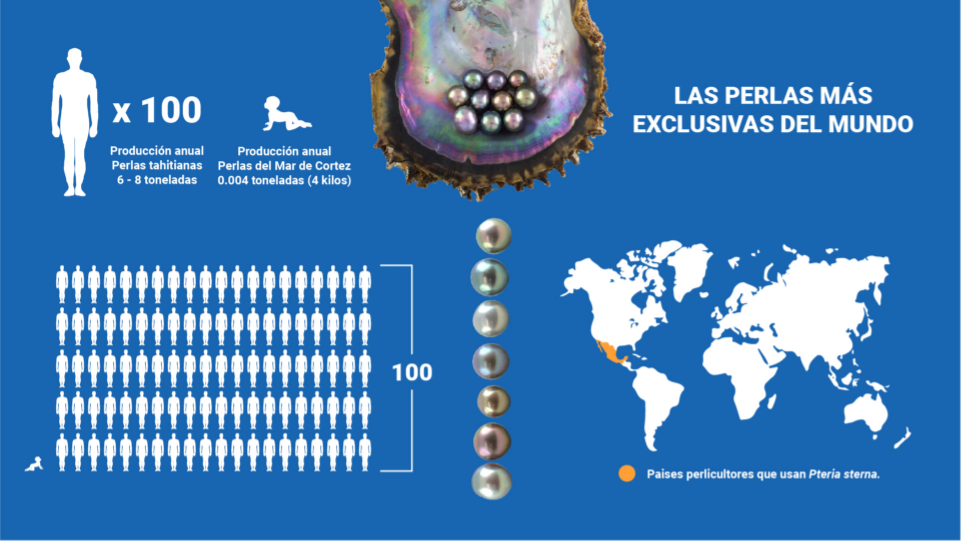
What makes these necklaces so special? Well, they consist of pearls produced in Mexico’s Gulf of California, a region known worldwide for its pearls, and these are cultured using a limited-production (4 kilos) scheme, these are the only cultured pearls that are produced under the “Fair Trade Gems” standards, the only cultured pearls that are produced using a “winged pearl oyster”: the “Rainbow-Lip Pearl Oyster“ or Pteria sterna, thus they are the rarest cultured pearls produced in the world and they also display a pink-red fluorescence under long wave UV rays, and are some of the very few cultured pearls that do not receive any “embellishing” treatments (physical nor chemical) … there are many more things to say about how special these pearls are, but this is just to lay the basics.
What we now need to do is present these three strings of pearls from the 2010 edition:
Necklace 2010 – A
This one consists of a graduated necklace with a length of 20″ (50.8 cm), made with 49 baroque pearls with a size (diameter) of between 8.0 and 8.7 mm, using “B” grade “Cortez Pearls” (“B” grade means that there are skin imperfections on the pearl and that its luster is not very high), the central pearl measure 8.7 x 9.1 mm . However, with its light gray color, unique shapes and its iridescent pearls makes it a truly exceptional piece. It has a simple yellow 18 K gold brooch.
This is an excellent pearl necklace when you consider its price:benefit. It is a baroque pearl necklace, but these pearls are soft baroques (not by human action), in short, although these pearls are asymmetrical shaped they posses very soft shapes that are almost spherical in appearance, thus they look “round” from a certain distance. It is quite uncommon for our Gulf of California cultured pearls to have a perfectly round shape (the reasons will be explained in a future post), thus our spherical shapes attain a far greater value than that of the most common shape: the asymmetric or baroque shapes-so this necklace achieves a relative low cost with great looks or “more bang for your bucks”.
This graduated multicolored 19″ (48.26 cm) pearl necklace consists of 51 baroque pearls with a size between 8.0 & 8.6 mm (diameter) and made with “A” and “A+” grade pearls (this means very good natural luster and a clean pearl surface) of exceptional colors. The result is a rainbow-like necklace with red, green, blue gray, black and purple pearls … As with the previous necklace, it features a plain 18K yellow gold brooch.
Special Edition “Bicentennial” 2010 Pearl Necklace
This is a truly a unique Cortez Pearl necklace, a piece of jewelry fit for a Queen and truly something that very few can own. We’ve placed this necklace at the same level of delicacy -for want of a better word- as some of our finest necklaces such as “Stella Maris” (2009) and “Bohéme” (2008). The central pearl is a gorgeous purple pearl (11.6 mm) with incredible green overtones (obtained from the 2010 harvest).
This 19″ (48 cm) graduated multi-colored pearl necklace consists of 49 near-round Sea of Cortez Cultured Pearls with sizes between 8.7 and 11.6 mm (diameter), and was made using the only “A+” and “Gem” grade pearls, featuring the most intensely colored pearls available, the highest natural luster and the best surface (“skin”) purity possible using only non-treated pearls. This necklace does not include a clasp, since the buyer usually acquires a specially made clasp for such a unique piece.
So far we have named this necklace as “Bicentennial” (Mexico turns 200 years old as an Independent country this year) but this name will be changed by the owner: in the purest pearling tradition these unique necklaces are named or are “christened” in the manner of other famous necklaces or Pearls of old. In today’s world, the vast majority of necklaces produced do not even deserve a nickname… but high quality pearls with a limited production are still worthy of this distinction.
Where are the other Cortez Pearl Necklaces?
Since our Bacochibampo Bay farm started producing loose cultured pearls in the year 2000, we have only managed to produce eight special pearl necklaces -with characteristics similar to those of the “Bicentennial” necklace- and we have always wanted for these to remain in Mexico, but this has not always been possible. So where are these necklaces? Here’s the list:
- 3 necklaces in Mexico, including the three most perfect and beautiful: “Stella Maris”, “Bohéme” and “Balandra.”
- 2 in the United States of America (“Maria” and “Isabella”)
- 1 in Italy
- 1 in New Zealand
Understandably, the owners remain anonymous. In the case of “Bohéme” it had the distinction of appearing in the book “Pearls” by gemologists Hubert Bari and David Lam, a book where the authors state (on page 86) the following about the “Sea of Cortez Pearl”: “It is perhaps the most beautiful pearl to have been cultured up to now” (Hubert Bari & David Lam. 2010. Pearls. Skira . Italy. 336 pages).
Where will the “Bicentennial” spend its Time? What will be its final name? That will be known soon …so, stay tuned!
That’s right, we have already published on the web -thanks to YouTube- our Original video on “Sea of Cortez Pearls.” This was a project we had in mind for several years, but we never had the time to invest in an “original production”. The video reached a good compromise between what we wanted to play on the video, yet we could not achieve such as: we wanted a video clip of a hurricane in action on the pearl farm … but when this happens one usually take refuge in your home, or special clothing (we could not shoot a troop of “Spanish Conquistadores” trudging through the desert) and,we were not able of getting a professional narrator (primarily due to time constraints) for the Spanish version of the video… but the English version has superb narration.
Despite being produced in 2008 (it achieved “Gold” status on December of that year) we had the video available only on DVD throughout 2009, and it was until this year that we decided to share it publicly.
The video is presented in two parts due to time constraints imposed by YouTube. The first part is a presentation of the Gulf of California Pearl:its lore and History; the second part deals with the commercial cultivation of pearls in Guaymas, Sonora. So, with no more hesitation: we hope you enjoy the video…
We thank all those who participated directly in this beautiful project, specially the staff of “Cheque’s Films” from our good friends Ezekiel “el Cheque” Núñez and Esteban Ibarra (who were in charge of cameras and video editing), the original “Perlas del Mar de Cortez Soundtrack” was the work of Jaime Delgado Avelar,the excellent voice narration by the professional narrator Charlie Bloomer, and photos taken by another good friend, Alberto “el Gordo” Tirado. Another couple of good video details provided by our friend Benito Sarmiento (thank you for allowing us to use your videocam and “casing” as well as for lending us your aerial video of Bacochibampo Bay), and finally, the great 3-D work of the “Spanish Galleon” done by Abraham Castro of “Onix” fame. In all, this video was made 100% in Guaymas, Sonora.
The script for the video was produced by us (“pearl trio”), in addition to video footage and photos that we did and incorporated into this video.
Additional thanks? Sure! There are many people who we would like to give special thanks, and amongst them we have:
“The Yaqui Diver”/Adrian Amarillas Casillas, our friends Rocio Mendoza and Diana Alvarez, as well as to Karla Valdez, Sergio Farell -our friend and former mentor- the ” Tec de Monterrey” for showing faith in our school project and, of course, our group of “Yaqui Workers” led by Jesus “el Pipi” Valenzuela.
I invite you to please leave your comments … I know that in order to leave a comment you are required to use an e-mail account, but for those who do not want to leave a comment because you will “need” to use your e-mail, you can do the following: there is no need to enter a real email … instead use this fake e-mail chachalaca@chachalaca.com.mx (“copy & paste” and place in the appropriate field) and you will see that it is not necessary to use your personal mail.
See you next week!
Returning to the subject of hurricanes and tropical storms … a subject that causes our skin to start prickling . For years we have suffered from the ravages of hurricanes, which mostly visit in the shape of tropical storms here in Guaymas. But for some unknown reason, at least for us, some of the most devastating hurricanes have been those that have hit other regions, far from Guaymas, such as 2005′s Hurricane “Wilma” in the Mexican Caribbean (which destroyed our sales store in Cozumel.)
This time we go back to 2001 when a hurricane called “Juliette” struck the coast of Baja California Sur, Sonora and Sinaloa, causing heavy rainfall and leaving behind a trail of death and destruction: perhaps Cabo San Lucas was one of the most affected sites in northwest Mexico (since the hurricane formed off the coast of Central America and also hit the coasts of Oaxaca and Michoacan). Precipitation on top of Cabo was of 449.6 mm, since the hurricane lost strength just above this small town and it remained “parked” on top for several days.
Barely a week after the celebration of traditional festivals of Independence, on September 25th to be precise, this typhoon was dangerously close to the coast of Baja California Sur. In Guaymas, Sonora, felt the effects of “Juliette” with the presence of heavy rains, but … how did our Pearl Farm become affected? In those days we had a Jewelry-Boutique that sold our “Sea of Cortez Pearls” (jewelry and unset pearls) smack in the middle of Cabo San Lucas. This was our first foray into the retail sale of pearls and jewelry in a “foreign” setting, and after having tasted success in our first location within Tec de Monterrey-Campus Guaymas.
Pearls of the Sea of Cortez – Cabo San Lucas
Our store was opened in January 2000, with the local manager of our friend, Mr. Rodolfo Brajcich, and with the presence of Dr. Alberto Bustani Adem, Rector of the Tec de Monterrey, Dr. Guillermo Soberon Chavez then Director of the Guaymas Campus, and Mr. Farell Sergio Campos, leader of our team.
Among the many visitors to our jewelry store, we had a good friend and his team of students: Dr. Carlos Rangel Davalos (co-authored the technical book of pearl oyster aquaculture). Among this group of students was Hugo Ruiz Rubio (another good friend of La Paz, BCS) … who visited with their first batch of experimental Mabe Pearls, produced for the Autonomous University of Baja California Sur (UABCS).
There were great expectations for this store site, due to the presence of cruise ships in the area, but unfortunately this commercial experiment came to an end with Hurricane “Juliette” and the responsability to close this store fell to the new manager, Miss Monica Ocon … and here we closed yet another historical chapter.
And now many will be able to understand our reluctance to open a new branch/store outside of Guaymas, Sonora … we have already done this twice and the stores have had to close for the same reason: Hurricanes …
Until next time!
Once more we are here, sharing our thoughts and hearts with you…hoping you will allow us to guide you into the history of the Gulf of California Pearl. I hope you find the story of Dr. Gastón Vivés feats as enthralling as we did when we first learned of his existence in 1991. So this week we continue with the most important area of the “CCCyP” or “Pearl Farm”: the “Raceways” or aquaculture channels.
When flying over Isla Espíritu Santo you will easily be able to distinguish the little bay and estuary where this famous pearl farm once stood, this because you can clearly distinguish the man-made shape of the culture station. This part of Dr. Vivés’ operation was a special as all others, but this one is the one most people can see, touch and easily comprehend in its operation. After almost 100 years of abandonment, harsh weather and even hurricanes, this area is still in good condition but slowly being overtaken by the mangrove forest.
This little “ensenada” or harbor has a small mangrove forest growing in typical estuarine fashion: you have a little inland lagoon with its sides all covered with mangrove trees. Gastón Vivés must have “cleared” some of the mangrove forest in order to improve the pearl culture environment, because pearl oysters are not commonly found inside these lagoons. The problems you usually have when you work in an estuary such as this one are the following:
- Increased salinity levels during summer months
- Decreased salinity levels after the rainy season
- Higher/Lower temperatures than those in the ocean
- Reduced oxygen levels.
- Lots and lots of mosquitoes and some terrible little -almost invisible- bugs we call “jejenes” (No-see-ems???)
But on the other hand you also have important benefits such as:
- Higher than average productivity levels (food)
- Easier handling of animals in shallower water
- Secluded area, easier to protect
So, it is obvious Dr. Vives decided to remove a portion of the mangrove forest and use it to grow his black-lipped pearl oysters (Pinctada mazatlanica) instead. It is hard to know if they dredged the bottom of the lagoon in order to remove the usually black-muck (highly organic mud) that is commonly associated with these forests. It could have been, but maybe they just closed the communication between the ocean and the lagoon…then they cut the trees, allowed the bottom to dry and have workers remove the anoxic muck and then prepare the bottom with more adequate conditions such as “tepetate” rock. This also gave them time to work with the masonry.
I can imagine this was a very intense workload for those involved. Why? Let us go back to 1890 and imagine that the World was different: sailboats on the remotest part of Mexico, a desert island with little or no food and fresh-water available, high temperatures of 45 Celsius (over 120 Fahrenheit) during midday, poisonous snakes and arthropods, mosquitoes, no medical help…you can keep adding it up. So, you not only needed workers, but logistics that are similar to those needed to fight battles and win wars: those that cannot supply their armies are the ones that will loose. And it was an army that Gastón Vivés had to take care of: at the height of the farm’s operation it is said it had over 1,200 men working on the Island.
So, among all the things he had to do is have his workers build barracks and other areas needed to establish and serve a large contingent of people. The docking area would have been important as well, because you need constant transportation of people and goods from La Paz to Espíritu Santo, and drinking water would have been a problem (although several fresh -and some briny- water springs are identified on the island). In order to obtain meat, goats were introduced and allowed to forage the desert shrubbery…something that nowadays is considered an “ecological nightmare” (but in those days the notion of “ecology” was non-existent). Once the whole site was constructed it would no longer be the peaceful island but a noisy bustling place of activity (heck! we’ve got towns in the “sierra” that have only some 88 people… and this place had hundreds of workers!): cooks cooking, iron-smiths bashing iron, carpenters nailing planks, divers, packagers…everything but plumbers and electricians.
The Nursery System
About the Masonry work: marvelous. He had great stone-smiths (for a lack of a better word) that -in my opinion- were serious artists and cared about quality. They used dark/red volcanic rocks to form the canals. Their amazing masonry work looks quite sturdy in most places, but the roots of the mangrove are slowly destroying them…
Inside the canals or water-channels it was possible to see some fish darting in and out (usually the common “Lisa” or “Mullet”), as well as an aggressive little Blue-Crab (Callinectes bellicosus). The water is mainly murky-green: thick and rich with nutrients. The water is shallow and has very little movement, the bottom seems more sandy instead of the black pudding-like muck you find at other estuaries (maybe I just needed to stand there until I sank…but did not have much time).
This place would have looked somewhat different some 100 years ago, because this part of the farm was entirely covered: it had a great “palapa” roof made with palm fronds (I did not see a single palm tree here, so the fronds would have been transported from the mainland as with most other things such as wood) and wood beams (very much like the palapa we employ at our Guaymas pearl farm today).
The reason for these roofs is simple: the sun is strong at this latitude and it warms the water; warmer water usually holds less oxygen and some creatures can suffocate… so, just add some shade and the water’s temperature will be cooler. Smart man. In winter you would have the opposite problem (cold water) so you can remove the palm covering and the water will warm up.
This raceway or canal system was very important because it was the “nursery system”, the place were the delicate little juvenile black-lips would be kept under constant surveillance. Why? Well, he did choose a lagoon…and these are well stocked with blue-crabs and these just adore little oysters for their “botana” (tastier than nachos). So, guards were places on top of the canals, armed with fork-like lancers and ready to defend the little pearl oysters. But many other creatures could have wanted to enjoy a free lunch as well: but mainly the octopus, snails and starfish.
The canals had wooden planks to allow the guards to move easily from one place to another and chase the intruders. Also, when the water from the canals was taken out (during the low tide) people would be able to jump inside and work with the animals, perform close inspection and even remove some predators that could have escaped from the guard’s watchful gaze.
The bottom was “conditioned” as I mentioned before, but the little juveniles were not left on the bottom just sitting. Nope. This was all worked out in detail. The little oysters were introduced inside small metal mesh cages, shaped like rectangles. We found the remains of several of these cages at the island…all oxidized, but of course plastic was unavailable in those days.
These juvenile oysters were obtained using special “spat collectors” (of a special design, and we will talk of these in the near future), and the little creatures must have measured some 3 cm (about 1 inch) when caught.
At this stage, the oysters are quite delicate because their shells are not hard enough to protect them and they have a special “anchoring” system (the bissus) they employ to grab a hold of a rock or coral and it is quite delicate: you should never pull them. Also, their small body size does not give the oyster enough protection from sudden temperature changes (they can heat easily under sunlight, and if placed rapidly in cold water the shock can kill them)… so it seems very likely Dr. Gastón Vivés’ medical training might have given him a very sound foundation to understand the oysters and give them the best possible conditions to improve their growth and survival.
By means of the mesh cages, it was easy to handle many oysters at once and protect them from most predators and he would have been able to reduce mortality rates to very tolerable levels (5-20%) at an age when -if you don’t do the right things- you can have a mortality rate of up to 80%.
Truly a revolutionary man and way ahead of his time… let us continue with this account in the coming weeks. In the meantime, you can watch a small video about our visit to this historical site. The video has titles in Spanish only, but if you read this entry you will be able to grasp the meaning…I will add sub-titles to the video in the future.
Welcome to our “Sea of Cortez Pearl” Blog-site. We are a group of Pearl Farmers located inside the Sea of Cortez (Gulf of California, Mexico) and our plain intention is to open up a channel of communication between us and those of you that have been -or will be- our guests-visitors at our website and pearl farming facilities, a place where we can talk about subjects that revolve around our beloved marine gem: the environment, quality, cultural heritage, stories & myths, jewelry and jewelry designers, pearl farming and our pearl oysters.
Welcome! and stay tuned for new posts.

- How do pearl farmers look like?
Manuel, Douglas & Enrique – Owners and Founders of Perlas del Mar de Cortez
Douglas