The Tucson Gem Show 2012

Jan 23

We are currently preparing for our yearly Tucson Gem Show, so I’m using this opportunity to invite you to come and visit our booth at the GJX tent from January 31st to February 6th.

For us the Tucson Gem Show has been a tradition since we began exhibiting in 1994. We still remember our first exhibit at the “Rodeway Inn” under the banner of the G&LW, when most of the product we had to offer were our Mabe Pearls…fast forwarding to 2011 when our main sales at the GJX show consists of high-grade cultured loose pearls. So, this year marks our 18th straight year at the Tucson Gem Show…many stories & “adventures” to tell, as well as many fond memories.

Definitively: the Tucson Gem Show has remained as our only international gem show venue, and this is for many reasons: it is close to our headquarters (just a 6 hour drive), the climate is similar to ours, no jet lag, they have REAL Mexican food in Tucson, I’ve got family up there, the Mountains are beautiful…really much better suited to us than the shows we did in Guadalajara, Denver, Basel & Hong Kong. Then again: we always enjoy seeing the friends we’ve made over the years.

Below, you see a photo of our booth at the “Holidome” in September 1995. I am taking care of a plastic container while Sergio Farell unpacks other items, closely inspected by Manuel Nava and our friend Alejandro Rodríguez.

@ Tucson Gem Show 1995 - Holidome

The next year we had the chance of exhibiting at a big flop called “Atrium” and this is our booth. In those days we sold a lot of Sterling Silver & Cortez Mabe Pearl jewelry. Not a good show for me –personally- since I had to rush back to Mexico to my grandmother Emma’s funeral.

Booth Perlas de Gym en Tucson Atrium feb 1996

Some years later, we finally managed to move from the “Holidome” to the G&LW show. These are Enrique Arizmendi & Rodolfo Bracjich at our booth back in 1999.EAC y Rodolfo

And one friend we miss seeing at the Gem Show is Richard “Bo” Torrey, former editor of “Pearl World”. Lots of fond memories with Bo…here with Enrique Arizmendi.

enrique y Torrey

Placing the memories behind, let us fast forward to 2012.


The Cortez Pearl @ Tucson

We can once more be found inside the GJX tent (across from the Tucson Convention Center) in booth #508. This year we have a couple of things to show our visitors, including a magnificent multi-colored Cortez Pearl necklace: the first one for the year 2012. This particular necklace (code 2012-A) was on the designing table since 2009 and our associate Manuel Nava found the necessary pearls to finalize it just this new year. Although it does not contain any pearls from this year’s harvest, we decided to give it this year’s blessings.

Collage-Collar-2012-A

We will also have our usual assortment of loose Cortez Cultured Pearls, Mabe Pearls (including some blisters) and some Silver Jewelry items. So, come on over and check out our unique pearls, learn how difficult it is to grow these Fair Trade beauties and get all the information straight from the oyster’s mouth: we’ll be happy to share a moment with you.

Hope to see you at the Gem Show!


Pearl Fisheries in Northwestern Mexico, Part 3: Who was “El Mechudo”?

Jan 6

And we are back, with what will be the New Year’s first installment of our Cortez Pearl Blog, and for this year we hope to become your source for all interesting pearl related legends & environmental stories, plus other things interest. We truly can be considered a “micro-cosmic-blog” within the Internet, since all the “big bloggers” concentrate on the “macro-cosmic” nature of the internet: computers, smartphones, music, file-sharing and all sorts of money making ventures…this blog is for the few that love and care for this beautiful and unique aquatic gem: Welcome Back!

On October 5 I published the entry about “The Pearl of the Virgin” which detailed the observance of the region’s pearl divers to the Virgin of Loreto, so that she extended her mantle of protection against the dangers of the sea and to help them procure a good yield of pearls. Now it is the turn to talk about the man in whom this legend is embodied, and in order to continue our analysis we must start with a couple of questions: Who was this “Mechudo” diver? and Where did the story/legend take place?

The Identity of “El Mechudo”

On the identity of this man, very little is really known, but some information can be extracted from the myth. One thing is sure: nobody knows his name or his true origin, but all the stories tell of a diver of exceptional ability, most likely he belonged to the Sonoran Yaqui Indian Nation, and we also know that he was possessed of a huge black mane of hair, and hence the nickname of “El Mechudo” or –losely translated- “The mop” or “Long Haired One”, “mechudo” meaning “long & shaggy hair”. It is said that his diver’s was so long and dense that he never used a hat, instead, he tied his hair in a way that it served him as shade and protection from the harsh sun-rays.

Another reason we believed him to have been a native-American man -or mestizo or half-breed- from Sonora is that some sources mention another nickname that this diver also received: “Guama”, an incorrect wording of the voice “Guaima”, which was the name of a band-clan of natives (believed to have been of the Seri or Kum Kaak nation) who lived in Guaymas, at the time of the arrival of the Spaniards in Sonora. Here we have a small promotional video about this fascinating culture of the Sea of Cortez…it is in Spanish, but the photography is truly nice:

Seri Indian New Year Festivity at Desemboque Seri, Gulf of California, Sonora.

Anyway, at that the time when the legend developed, the best pearl divers were the Yaqui of Sonora, so it is inferred that he was just one of the thousands who were employed in the extraction of pearl oysters, but he could have been from any other place. But, the “Guama” nickname is basically telling us that he was a “Guaymense”, a man from Guaymas.

The Place of Action

But legend has it that our long-haired diver had no luck in fishing for pearls on a fateful day, in an unknown year of the late nineteenth century (probably in 1897, since this event is recorded in a local newspaper from La Paz), the events probably occurring between the months of May to September, when pearl fishing was practiced in the Gulf of California. But even with this information we simply do not have the way to know the exact day on which this event occurred.

Another unknow fact is the precise spot where this tragic event took place, because some documents state it happened just north of the city of La Paz, in the Baja California peninsula, whereas others went as far as mentioning more precise coordinates:

  1. Southwest of San Jose Island and 12 km from the bay of “La Amortajada”,
  2. 40 miles north from the port of La Paz and 50 miles in front of the island of “San Francisquito”
  3. between 24° 42′ 30″ N and 110° 40′ W (according to the old newspaper from La Paz).

However, the site is that is presently called “Punta El Mechudo” (or “Long-haired Point”) is located north of the Bay of La Paz, at 24° 48′ 26.30″ N and 110° 39′ 37.90″ W, and here we have some images of site (courtesy of  Google Earth ):

A visual inspection of the area reveals that there is a small sandy beach, a good place for resting and for a fishermen’s camp; but viewed from above we hardly see the presence of “dark spots” in the water, these being an indirect indication that we are in the presence of rocky/coral reefs (or even in patches of algae), which would be suitable for pearl fishing.

Although, at a closer look we can also discover that at a relatively small distance from the point (see arrow), and at a higher depth, there are some kind of aggregates seen on top of the sandy bottom; these could be made of rocks and green coral heads (Porites sp.).  These Porites or green corals are very common in the Gulf of California, and they are known to have Black-lipped pearl oysters attached to them. At this point it seems this would be a good area for pearl fishing. In the next photo you can see how these corals are shaped, depending on the environment they grow in: they are sometimes found as encrusting types (when growing on top of large rocks) and they sometimes form “clumps” or “heads” when growing in calm, shallow and sandy areas. We have been in areas where they are abundant in their massive form, as in “Espiritu Santo” Island, while in Guaymas they are often seen encrusting on rocks.

Collage-Coral-Porites-ENG

At this moment we know a lot more about the man -the main character- in our story, and we also know a lot more about the location where the legend took place. In the next installment will continue “chipping away” the legend of the “Devil’s Pearl”.

We wish all of our readers a Happy & Successful New Year!!!

Mabe Pearl Production #1: Origins

Dec 7

Here again with information we believe will be of interest to you, although we are taking a slight detour from our “Legend of El Mechudo” series (while I finalize the short video) and because many have asked us how Mabe pearls (or half-pearls, as they are also known) are produced, and how come they end with with a dome-like or hemispherical shape.

Some people think Mabe pearls are just pearls that have been cut in half (on the first photo we see a pearl cut in half –sometimes called 3/4 pearls- and a Mabe to its right), or when they see the Mabe still in their host-shell they may comment that it is obvious that the pearl is growing from the shell and that it will eventually become detached from it, or that they are “aborted pearls” and they just needed more time to “pop out” of the shell, a fully fledged and normal pearl, but they are mistaken.

Let us begin by explaining a bit about the origin of the equivalent of the Mabe pearl in Nature, followed by some of the initial techniques for their cultivation, until we revisit some of the modern-day techniques employed to grow this beautiful product.

But first: the natural origin of these “attached pearls”… a product that has been known under the name of “Blister Pearls” and of which we have already discussed in detail, but we will shortly review in this post as well.

Blister Pearls

As the name implies, these natural pearls resemble “skin blisters”. Many of these pearls look like a “bubble” on the inner shell of the pearl oyster, hence the name “blister pearl” is so appropriate.

These pearls are produced when certain boring organisms (such as drill-mussels or boring polychaete worms) produce little tunnels in the shell; eventually they come in direct contact with the soft organs of the oyster, particularly with the mantle: the organ responsible for the production of the nacreous shell of these molluscs. The oyster then uses its mantle to “defend” itself against the damage caused by these organisms.

If these “blisters” reach a good size, have a nice shape and have some beauty, they are then processed (cut from the shell) and then set unto jewelry. Thus, this type of pearl would be the easiest to produce, if ever a person attempted to produce them, both experimentally or commercially.

The First Cultured Blister Pearls

The origin of the first cultured blister pearls emerges from ancient China. That’s right, something like 13 centuries ago (from the V to IX century), when Buddhist monks managed the production of what for many was simply “a miracle” or “a kind of magic”. But to understand this “miracle” we also have to understand the situation of China-and its monks and population- at that time period.

Monks that Monkey Around

As with other monks of the time, these Buddhist monks lived in monasteries, were they practiced the contemplation of nature, meditated and, generally speaking, we can say that many enjoyed a lot of “free time”. Some of the monks may have noticed that in their ponds, where they practiced the cultivation of fish, some pearly mussels also developed, and one thing led to another: they found a way of introducing small lead figurines inside these mussels, and attached these between the shell and mollusk’s mantle; eventually, these little metal figurines were coated with nacre and had the shapes seen in the next image: little “Pearl Buddhas” (image taken from this site).

And what use did these mini-Buddhas served? Well, for many things including:

  • Religious Propaganda: little has changed over time and even less so among some religions that use some “miracles” to keep their “flocks” or to obtain new followers. A vast majority of the people of the ancient world believed that pearls were of divine origin, so that only a god or powerful spirit being (such as an angel) could produce them. If I happen to have a shell with small pearls with the shape of Buddha, well I’m showing that he has the power to produce pearls in his own image… clearly divine!
  • Payment of Taxes: Probably more important than the divine origin of the pearls is their use for the payment of taxes. And in feudal China (exactly during that time period) pearls could be used to pay your taxes. We all know there are two things that are truly certain in Life: Death & taxes. This was very convenient.
  • To Create Jewelry: Perhaps this was also a reason to produce them, but from the quality of the pieces I have seen (mainly in low quality) I don’t believe it. They must have been used mainly to adorn temples (many fine examples can be seen in temples in China today).

But many centuries had to pass… until the 19th century, for the commercial culture and production of the Mabe Pearl. We’ll discuss this in a future entry.

Until next time!

Is the Pearl I found in a Clam Valuable?

Nov 10

This is a short entry but I believe it may be of value to some; this entry originates from an email I recieved just a week ago, but we’ve received this type of e-mails several times before… so I will take this opportunity to forward this information to the widest audience possible. The e-mail I recently received comes from the “old continent” and says:

Good morning:

I’m writing from Spain to ask you:

Some time ago I had lunch at a seafood restaurant and I found a pearl inside a clam. It’s small but roundish and pink colored. Does it have any commercial value?

Thank you and kind regards,

Marta


My answer:

Hello Marta,

Interesting discovery… but to know for sure if it is of value we must first have the following information:

  1. Was the pearl found in a cooked clam (baked, fried, steamed)? A "cooked pearl” can lose its value because it loses its beauty when damaged by heat.
  2. The species that produced the pearl (its proper or scientific name): Most clams do not produce “true pearls” but instead produce "calcareous concretions" which have no real commercial value.
  3. Size and weight of the “pearl”: pearls have a greater value after attaining a minimum size (5 mm) or weight (0.5 g); if the weight/size is lesser than this size-weight, then the economic value is not very significant, but: You have have found a pearl! You’re lucky: natural pearls are rare.
  4. If the pearl is nice and large enough, you can have a jeweler incorporate it into a ring or pendant, as an "accent" for it.

Greetings from Mexico

Effect of Heat on a Pearl

All pearls have an amount of water content in their chemical composition (usually from 2 to 5%), and this water is important to maintain the integrity of the nacre in the pearl. Pearls are made of concentric layers of this nacre, which in turn is made from flat, hexagonal-shaped crystals of aragonite (a variety of calcium carbonate) which are bound or “glued” toghether by means of a special protein (conchiolin), which keep the layers of aragonite togheter.

If a pearl is overexposed to heat, it will loose some of its moisture and may fracture and may also become dull or opaque… and if any of these things happen, the pearl may lose its value (in whole or in part, depending on the degree of damage).

Pearl-producing species

Most people associate the pearl as a nacreous gem, although with the massive amounts of imitation pearls (faux perles) and processed (bleached) pearls available, many people associate the pearl as a shiny white sphere (with the look of polished marble). But the fact is that pearl oysters and other mollusks with pearly shells produce pearls in the “traditional” sense: nacreous.

But there are those mollusks that do not produce a “pearly shell” and have a shell that looks more like porcelain, and these organisms are said to produce "calcareous concretions" which are basically "non-nacreous pearls". These porcelain-looking “pearls” are made ​​primarily of calcite, another form of calcium carbonate (usually found in marble, limestone, bone, seashells and eggshells).

However, some species of mollusks are capable of producing non-nacreous pearls that have very special features, such as those from the “Lion’s Paw” scallops (Nodipecten subnudosus), various species of snails (including Strombus sp.) or the “Giant Clam” (Tridacna sp)… but these are exceedingly rare.

Perla-ManoLeon

Thus, it is vital to know the species that produced the "pearl", and you will have an easier way to know if your pearl could have some “real value”… or if will only have a “sentimental value”. In either case you can consider yourself lucky.

Size and Weight of the Pearl

These two indicators are very important to obtain the value of a pearl. Large pearls have always been rare and therefore command a greater value, thus a pearl with size of less than 5 mm in diameter may not have a great price, while one exceeding 8 mm will have a good value. If your pearl is small, it is better to just keep it… but if it exceeds 10 mm (diameter) you may already have something of value (Note: in addition the pearl should be beautiful and not have cracks, size is not everything).

And although a pearl’s weight is related to its size in a very direct way, this is not always true; such is the case of the so called “Gas Giants”. These pearls can reach very interesting sizes (12 mm and up), but they really possess a thin layer of nacre, and inside have a kind of "organic mud", putrid and foul-smelling… not the type of pearl you want to give away or acquire. These pearls usually have a large size and display a low weight.

The Pearl’s Beauty

For us the main attributes to consider in a natural pearl are:

  1. Physical Integrity: the pearl does not have any cracks or fractures, that its nacre is intact (undamaged).
  2. Size and weight: that its size exceeds 6 mm in diameter and its weight corresponds to its size.
  3. Beauty: even if you have the two previous attributes, the pearl must be beautiful. If it is not beautiful it has got to have some exceptional trait that will give it value; such as the gruesome but Huge "Pearl of Allah", or like the pearls of the Nautilus for their unusual spirals and origin.

We have to consider that the person who finds a natural pearl is very fortunate (and by this I refer not to the cultured pearls that are placed inside a farm-raised oyster/mussel, and sold in little cans) and even if their pearl may fail in one or more of these indicators, this does not mean you don’t have something special and unique!

If you’re one of the Lucky few: Enjoy your pearl! And, if you are not one of them: what are you waiting?!?! Go to your favorite seafood place and gulp down a dozen raw clams!!!


The Pearl Fisheries of Northwestern Mexico Part 2: The Pearl of the Virgin

Oct 19

Kicking off with this entry, I’ll start talking about the legend of the Yaqui pearl diver whose name has been all but forgotten and who is now only remembered for his nickname “El Mechudo” or “The Long Haired One”. My previous post contained a small fragment of this legend, as was heard and reported by Fernando Jordan in his book “The Other Mexico” (1967). But today’s audiences may not understand what the story is all about, being so brief and abridged, so I’ll start by first explaining this issue of “the Virgin”… why were the pearl fishermen relieved when they found “the Virgin’s pearl”?

The Virgin of Pearls

The virgin which is referred to in this legend is no other than the “Madonna of Loreto”, which is still inside the temple of the town that was once the capital of the territory of “The Californias” from 1697 to 1777: Loreto . September 8th marks the day of the “patron saint” of Loreto, when the worshipers of this figure walk the streets in a religious procession, carrying the image. This depiction of the virgin Mary and infant Jesus was brought to Mexico on the bequest of Father Francisco Eusebio Kino himself, although some sources state that it was not father Kino who carried it into the Baja California, but the Jesuit Salvatierra in the year 1667.

Here’s a picture of the “Virgin of Loreto” (which I got from this webpage: http://francona.com/travels/mexico/cortez.html ).

Just as it was required to pay the “Quinto Real” or “King’s Fifth” (a special tax, typical of feudal Spain’s colonialism in Mexico) when fishing a pearl oyster bed or a in a mining operation or when a “treasure” was discovered; in those days, the pearl fishermen and pearl armada owners would offer up a pearl to the Virgin of Loreto out of the pearls they extracted in a given day (some references cite a pearl for every 10 pearls or 10%, which is equivalent to the traditional “tithe“). In this way, fishermen would have  the “blessing” of their “patron saint” and they would have a good pearling season.

Now that we can understand the reference to the “Pearl of the Virgin” within this story’s frame, we can continue to examine other aspects of the legend, such as that of the “Perla del Diablo” or “Satan’s Pearl”, but that will in a future post.

The Mantle of the Virgin of Loreto

Perhaps more famous than the “Maddona of Loreto” herself, is the mantle that she does not have anymore. One of the many thefts of sacred art that have been perpetuated in Mexico (see the entry on “The Virgin’s Pearl”) and many other Latin American countries… but in this case the thieves did not steal the image’s clothing (being just plain textile) but they focused only in its “mantle“, a type of cape that protected the image and on which the wives of the pearl fishermen would sew the pearls offered up as tribute.

Suffice it to say that after decades of adding up pearls to this mantle, it was quite a treasure and thus attracted the attention of thieves; neither the thieves nor the mantle were ever found…

It is interesting to examine historical records and find out that such thefts have been all too common in Mexico and even with several images of the “Virgin of Loreto”: many of these religious images have been stripped of their jewelry and clothing (this link will download a PDF file containing the theft of many religious images throughout Mexico and through the ages). However, I could not find a single reference to this particular theft, and I have been unable to find some of my original sources in our “arcane” (paper) library.

In my next blog-entry I will start by comparing two versions of the “Legend of El Mechudo” and will offer up additional details and I will even propose my version of the tragic events of this great regional legend, but -of course- it will be covered with technical details that I’m sure will be of your interest.

Until next time!

The Pearl Fisheries in Nortwestern Mexico, Part 1: Background Information.

Oct 7

A recurring image I have had in my mind for the last couple of months is that of a drowned man floating in the sea. Grim dream, to say the least. And in connection with this dream, just a few weeks ago I was looking for information on the Smithsonian Museum (will tell the reason in aun upcoming entry) and there I found this photo of a sculpture of one Benjamin Paul Akers, called "The Dead Pearl Diver" and I felt like it was time to talk about the pearl fisheries in Mexico’s Northwestern region and give my try at the legends of the Yaqui pearl divers, including the famous legend of  "El Mechudo" (or “The Long Haired One”), which I once wrote about in our official website.

But before touching the subject of legends and myths, let us first talk about facts.

The pearl fisheries in Baja California Sur and Sonora

The Pearl fisheries in Northwestern Mexico depended mainly on the use of Yaqui pearl divers, a native nation of Sonora. At the time when the legend of "El Mechudo" appears into history, many Yaqui were had rebelled against the governments of Sonora and Mexico. The President of Mexico, General Porfirio Diaz – ordered the arrest of all rebellious Yaquis and had them sent off to work at the haciendas of the far off State of Yucatan … and hence comes the name of this sector within the City of Guaymas, Sonora, known as "la Yucatan": this was once a “prisoner camp”, from which the yaqui were sent to Yucatan. This dark period of our regional and national history is known as the "Guerra del Yaqui". Many Yaquis were sent to work for the owners of the pearl fishing fleets of Sonora and Baja California Sur. We are therefore in the period that marks the end of the 19th century and the beginning of 20th.

In those years, the pearl fishery was an important part of the economy of Baja California Sur but was somewhat less for Sonora (which was already had a more diversified economy), but most of the revenue ended up benefiting a few families: that of the shipowners. The divers obtained work, a roof in a barrack and a few meals, and a very dangerous work environment.

In this situation, it is easy to understand the great enmity that existed between these two groups of Mexicans: the "white" or "Yoris" and the Yaquis . This created for a tense working releationship: how could the men in charge of the fishing crews (usually a “Yori”) give his men (Yaqui) knives for the extraction of the pearl oysters? The knives could easily have been used to cut their hearts out!

But, how could the Yaqui divers protect themselves from the attack of the fearsome sharks?!?! Some sources mention that divers were armed with a sort of "wooden stick" (a stave, which could have also been used to kill a person in true Van Helsing fashion); other authors state that the death of divers due to shark attacks was overrated, so it is very likely that in many occassions divers did not employ any defensive device, altough Vicente Calvo mentions several of the dangers afflicting the pearl divers of Sonora in the 1840′s:

… But the Manta-rays, would quickly throw themselves over them (the divers), and would compress them against the bottom and then they would drown within minutes.

Being truthful: I do not think the latter is possible. I have never seen or heard of a Manta-ray performing this type of maneuver; but if a diver actually believed that his death could happen if attacked by one of these fish, then he might go into a "panic attack" and end up drowning due to his own fears.

Pearl Fishing was carried out from a "mothership" from which descended several small boats, each with 2 to 4 men, and thus they managed to cover most of a fishing area of a "pearl bed”. Divers dressed only with a loincloth, and would throw themselves from the boat, some helped with primitive weigh-stones to help them quickly reach the bottom. We can watch this activity when watching the classic Mexican film "La Perla", if you don’t have access to the movie you can also watch this short video that contains a few segments of the movie (watch the action at around 1 minute & 25 seconds):

Short History of the Cortez Pearl

The divers descended to depths between 2 and 26 meters ( 6-86 feet) to find their catch of pearl oysters. Sometimes the physical exhaustion caused by continuous fishing (they dived for up to 6 hours daily) and lack of drinking water and food (did you perhaps believe that divers received an adequate nutrition?) caused some to lose consciousness and drown.

Again we have the description of Vicente Calvo on the pearl fishery of Sonora (and I place emphasis here, as many people believe still that only Baja California had a major pearl fishery):

Fishing starts in June and ends in October, using two or three boats from 40 to 60 tons each. In early November, these boats begin to arrive at the Port of Guaymas… the average time spent by the diver underwater is of one and a half minutes, but in such a short dive-time each divers collects many oysters.

Pearl fishing in the Sonoran coast began when the waters warmed enough and stopped when it is cooled off. The Gulf of California is a sub-tropical sea, so we have ample temperature differences between summer (with 32/90 degrees Celsius/Fahrenheit on the surface) and during winter we have recorded up to 12/53 degrees Celsius/Fahrenheit here in Bacochibampo Bay). Unfortunately, this pearl fishing period also coincided with the breeding season of the "Panamic Black-lip Pearl Oyster" (Pinctada mazatlanica), so that the effects of fishing were doubly harmful to the populations of this particular pearl oyster.

Another interesting description of Vicente Calvo states that:

All divers feel -at the beginning of each task- how blood flows from their noses, and they see this as a good sign, and will continue –happier- with their work, which lasts no more than six hours.

And this brings us to another reference to the hardships associated with fishing for pearls, but this time by an British Lieutenant by the name Robert William Hale Hardy, who in the 1820’s visited various spots within the of Sea of Cortez -including Guaymas- and he even dived for pearls at the bay of Mulege, and so he states about this occassion:

…I felt myself gliding through the slippery water, which, from its density, gave one the idea of swimming through a thick jelly; again I experienced the same change of temperature in the water as I descended; and again the agonizing sensation in my ears and eyes made me waver. But now, reason and resolution urged me on, although every instant the pain increased as I descended; and at the depth of six or seven fathoms, I felt a sensation in my ears like that produced by the explosion of a gun; at the same moment l lost all sense of pain, and afterwards reached the bottom, which I explored with a facility which I had thought unattainable.

…I no sooner found myself on the surface than I became sensible of what had happened to my ears, eyes, and mouth; I was literally bleeding from each of these, though wholly unconscious of it. But now was the greatest danger in diving, as the sharks, mantas, and tintereros, have an astonishingly quick scent for blood.

R.W.H. Hardy. Travels into the Interior of Mexico in 1825,1826,1827 and 1828.

This was really a risky profession in many ways, and divers would find their lives shortened and their health compromised… in the above cases we can see that the diver’s body is subject to a bleeding nose and the bursting of their eardrums…or even being drowned or devoured.

The Legend of "El Mechudo"

This is probably one of my favorite stories or legends which references to the pearl fisheries in our area, and it’s a very Mexican –and Sonoran and Lower Californian- legend. This story has been described in several other sources, including the blog of my friend Benjamin Arredondo, author of one of my favorite blogs "El Bable". However, I think there are things that should be reconsidered within this legend and then reinterpreted so that it has more shades of reality… and what do I mean by this? There are certain details that make the story quite unrealistic at some points, but by re-focusing these it can turned into a real story.

Well, so far I’ve written a lot about the fisheries… and nothing of the legend. So, this is waht author Fernando Jordan mentions about a site near La Paz known as "Punta El Mechudo" (“Long-Haired One Point”):

Southwest of San Jose Island and 12 km from ‘Amortajada bay’ and at the end of last century (19th)  there existed a pearl bed that was a good producer of pearls, and on which hundreds of divers gathered every year. At the end of each season, before the cold north winds made ​​diving impossible, the fishermen would prepare to take one last dive to offer a pearl to the Virgin’. On one occasion a diver was preparing to jump into the sea for the last time, when someone warned him from attempting it, he shouted:

‘No more do you need to dive. We already have the pearl of the Virgin’

The fisherman, made ​​a gesture of disdain, and replied scornfully:

‘I am not going after the pearl of the Virgin, I’ll get one for the devil.

And he jumped into the water.

Satan took him to the sea-floor, and the fisherman did not reappear nor did the sea return his body. This place is now taboo, and no one goes there to look for pearls. Those who have, state that they found -at the very bottom- the blaspheming diver’s ghost, who has grown long hair and a huge beard and a long tongue. It seems alive, and in his hands it holds a huge mother-of-pearl shell. It is the ‘pearl of the devil’ they say, and because of the long-haired ghost the place has been given the name ‘El Mechudo’.

Fernando Jordan “El Otro México”, 1967


This is –if it can be called this way- the “official version” of the legend, and as you’ve read, it is also known as the "Legend of the Devil’s Pearl". In the next blog entries I will begin to “break down” this legend, and will hopefully come up with an alternative ending for the legend, but the next entry deals with this issue of the “Virgin’s Pearl”.

Until next time!

Our Newest Designer–Alma Flores

Aug 31
Posted by DougMcLaurin Filed in Jewelry Designers, People & Pearls

As Mexican producers we have always taken pride on the excellent quality products that our fellow countrymen produce -in various regions of our vast and beautiful country-  whether it is organic coffee, flowers, art, fruit & vegetable produce, semi-precious stones and precious gems and –of course- silver jewelry. Therefore, we look for people who have a similar mindset to create synergy with them and enhance our wide range of unique jewelry with Sea of Cortez Cultured pearls.

On this occasion we are pleased to introduce you to Alma Flores, a succesful lawyer and designer, native of Navojoa, Sonora, and that manages a true Mexican mystique in her unique jewelry designs: from the selection of the pearls for her jewelry, the leather and wood used to make her splendid design cases and the way she plays with colors and textures… a true "Mexican Fiesta", where her jewelry items share in their joy, their festivity and their elegance.

All of Alma Flores’ jewelry items are part of her concept "Souls of Mexico" (“Almas de México” in Spanish) and are made ​​using the purest silver available (either 0.970 and 0.999, as requested) and on this occasion I would like to share with you an exclusive line with Cortez Pearls and which is called “Ostra” (or "Oyster" in Spanish), inspired on our "Mother of Pearl oyster", the unique organisms responsible for producing our beautiful cultured pearls.

The following information comes from the brochure of this innovative designer:

Alma Flores, has loved different cultures and traditions since she was a child. Always remembering the traditions from both the Mexican culture and those from abroad, she has taken the best attributes of each and combined them together to enrich each in her jewelry designs. She has captured her diversity of experience to create unique jewelry with a very high quality of workmanship.

Alma believes that fine jewelry should represent the personality of the person who crafted it and the work must provide the owner an experience of elegance, transforming the different cultural traditions to the modern and contemporary.

She has brought her creative spirit to make the ordinary extraordinary. Her passion for her culture and its jewelry traditions has led her to focus all of her knowledge and experience to enrich her designs with a personal touch of elegance plus universal appeal.

Alma’s idea goes beyond the design and quality of each piece. Her concept will allow each of her customers to own a registered design that can be worn both on a day-to-day casual basis or enhance the most elegant dresses.

Recognizing the potential and appeal of Mexico to the world at large, Alma believes fervently that Mexico can influence design worldwide, creating new trends and enhancing existing ones. With this vision, she has decided to show to the world and her native Mexico the quality of workmanship, the diversity of materials, and the unique creativity that Mexican craftsman have to offer in each of her pieces.

We have complete set of Alma Flores’ jewelry from her "Ostra" line, where the only thing missing are the pearls…but this is done to have the customer choose just the pearls he or she wants: each person can select just the pearls they want: their size, shape, quality and color, based on their personal taste or needs.

The complete set of "Ostra" is made ​​in 0.970 silver and includes:

  • 1 Gem-Quality Cortez Mabe Pearl Bracelet.
  • 1 Pendant
  • 1 Ring
  • 1 pair of earrings
  • 1 pair of cufflinks

The purchase of these items allows you to receive a special certificate issued by Alma Flores and a beautiful and stylish case made ​​from 100% natural materials (Mexican leather and wood). Truly a gift that can not be purchased just anywhere.

We hope you have enjoyed Alma Flores’ pieces as much as we do and we wish her much success in the jewelry stores where these items have been submitted for sale such as in "Optional Fine Art Jewelry" stores in the cities of Sarasota and Martha’s Vineyard in the United States of America, and in Richmond and Vancouver, Canada and -of course- here in Guaymas, Mexico.

So, our customers now have a new option in terms of our unique jewelry designs, right here in Bacochibampo Bay, just next to the pearl farm…so come on over and admire the works of all of our exclusive designers!

Until the next installment …

Pearl Ruckus 2011

Aug 30

Well, this isn’t really a “freshly-made” blog entry (I actually had it in the Spanish language version of this Blog since August 9th) but have not had the time to translate and proof it. I know: in these days of “instant translators” (such as Google Translate & Bing Translator) it should really be easy to just pop-in your text, get it out and be done with it…but some of us prefer to do things the “ole fashioned way”: using our brains and typing text. So, here is my review of this year’s “Pearl Ruckus”…

In the previous entry announcing he would travel to Los Angeles, California, to participate in the traditional "Pearl Ruckus" organized by the American Pearl Entreprenaeur Jeremy Shepherd, in order to gather toghether friends of what is probably the most important international pearl forum on the Internet: Pearl-Guide.com

Hollywood: Pearls we bring to you!

So, keeping to our appointed date (from July 22nd to the 24th) we all met in a beautiful mansion near the hill with the “Hollywood” sign … you will have to please forgive me the lack of photos but my camera "died" unexpectedly and the few images I was able of taking were using a borrowed camera (Thank You Sarah!). A total of 18 people came toghether thanks to the true hospitality and generosity of our hosts Jeremy & Hisano; we all had the opportunity to share & learn more about our fascinating gem (the pearl of course) and the changes that are happening within this industry.

Presentations

On Saturday 23rd we had 3 presentations and a special necklace-making session. Presentations were given by:

  • Josh Humbert, pearl farmer from Ahe, French Polynesia. Josh is a black-pearl producer that takes pride in his high quality pearls grown in an environmental friendly way. Josh explained his “biological cleaning system” (which he calls “the silent workforce”) based on the use of reef fish, which are used to clean his pearl oysters and avoid labor costs. This is a very interesting system that also allows his farm to avoid pollution increases the local fish populations.
  • Douglas McLaurin of Guaymas, Mexico, with a discussion of the positive Environmental aspects of the operation of a pearl farm in the Gulf of California. This activity seems to have had a very positive effect on the repopulation of the native pearl oyster species and that will be also be used to enhance the reproductive potential of other native species.
  • Jeremy Shepherd Blaire Beavers gave us a very interesting talk about the new Chinese "Metallic Colored Freswater Pearls" (which some have called "Edison Pearls") and that are now being offered through Pearl-Paradise.com.
  • Hisano Takei, a very talented designer, was responsible for a special “designers & jewelry workshop”, among which we could find Caitlin Williams (moderator of the Pearl-Guide.com’s forum) and designers Sarah Cannizzaro (from Kojima Co.), Patricia Saab, Sheri Jurnecka, Cathy Tran, Cinde Newberry, Wendy Weaver, and Marianne Carter…

All these activities are conducted in a relaxed atmosphere that made ​​you feel as if in a group of good old friends instead of a formal, business-like meeting… this was –of course- a matter of pleasure for us all: the pleasure of talking and sharing our passion for all pearls.

By the way, Sarah Cannizzaro also made her own Pearl-Ruckus blog entry, which you may enjoy here!

Pearls and More Pearls

We all had the opportunity to showcase our best pieces: pearls from all corners of the world … Josh had his "Kamoka" black pearls, including a huge 18 mm diameter cultured black pearl, Sarah Cannizaro designed a uniquely-original “pearl tiara” incorporating various types of pearls: kasumi pearls from Japan, Chinese freshwaters and even a Cortez Mabe Pearl (by the way: the tiara had a tremendous success among us), Douglas had a pair of very special pearl necklaces and a group specially “Cherry picked” Cortez Cultured Pearls from the 2011 harvest, Patty had a very long string of Cortez pearls (measuring some 50 cm in lenght!) and she also had a very nice necklace made with "Osmeña Pearls" (made ​​from Nautilus shell) and -of course- Jeremy had the opportunity to show us the reason why he is sometimes considered as the "King of Pearls": not only because he travels the world in search of some of the finest pearls, but because he had 6 kilos of the so-called "Edison pearls" (which I prefer to call “Metallic Pastels”).

A touching moment occured when Jeremy thanked Caitlin for her hard work at the Pearl forum and gave her a beautiful necklace made with natural “Basra” pearls from the Persian Gulf region, complete with certificate of authenticity.

Acknowledgements

To all who attended and made ​​this the very best "Pearl Ruckus" ever. And, very importantly, I want to Thank our hosts Jeremy Shepherd and Hisano Takei, who made ​​us feel –at least for a couple of days- as authentic "Pearl Kings and Queens”. Next year’s Pearl Ruckus is rumored as if it could take place in the Philippines, with Jacques & Christopher Branellec –of Jewelmer fame- acting as hosts … but this is still an unconfirmed rumor. Where will the Sea of Cortez Pearl go in the near future? We’ll just have to wait & see…

Finally, and totally out of the whole “Pearl Ruckus” theme… I took this picture of a sculpture made from scrap-metal parts (motorcycle parts, gears, automotive engine parts, etc.) made ​​in the image of the famous movie-monster "Predator" as it harpoons another terrifying movie-monster "Alien". We never knew the name of the owner of the Hollywood mansion were the gathering was hosted, but I assume –based on the presence of this "altar"- that somehow he might have been involved with this film series. Maybe.


Cortez Pearls now in Facebook & Twitter

Aug 11
Posted by DougMcLaurin Filed in People & Pearls

Oh yes! There is simply no easy way to avoid doing what everyone else is doing these days…every “Marketing Guru” out there says you have got to have a Facebook page for your company/brand and everyone needs a Twitter account. OK then…we’ve done it and have both.

If you feel the urge to follow us on Twitter then, just look for us as @CortezPearls. If you feel more like interacting with us using Facebook then head for our “Cortez Pearls” page (and while there, please do “Like” our page).

Twitter-PMC

So, this is an open invitation to the over 1,200 monthly visitors of this unique Blog…do come in and join us and find out what this “social media rage” is all about.

Both accounts will be BILINGUAL (English & Spanish) in order to avoid the hassles of having way too many accounts to manage…my primary job is still PEARL FARMING and for the likes of us farmers this does take some of our time away from our “wet & salty” obligations.

Anyway, we hope you enjoy this new channel of communication and that you will use it to your advantage. Hope to “see” you there soon!


Cortez Pearl Harvest Report 2011

Aug 2
Posted by DougMcLaurin Filed in About Pearl Quality & Grading, Natural Pearls, Pearl Harvests

I Finally I have the data from this year’s pearl harvest and it is a positive report but not a spectacular one. As it has happened for several ongoing years, environmental changes -possibly caused by global warming and other natural processes- have directly affected the outcome of our pearl harvest. This year was no exception since 4 years ago we had a very poor “spat collecting” season of "Rainbow Lipped Pearl Oysters" (Pteria sterna), which did not allow us to have an adequate amount of mature (2 year old) pearl oysters to “nucleate” or “implant” two years ago (2009) and the amount of pearls we obtained was of only 1.7 kg when our goal is to reach 4 kilos (roughly: 4,000 pearls)

However, the number of nucleated oysters would have given us only 1 kilo of pearls this year, but thanks to improvements in our nucleation technique we were able to achieve a 70% higher amount of pearls, and the colors and quality of the pearls were truly good.

I will now proceed to to review each type of pearl produced this year in our Bacochibampo Bay Pearl Farm…

Cultured Pearls

We harvested 1,783 cultured pearls with an average size of 9.0 mm (in diameter), the smaller size of the pearls was 8.3 mm and was larger at 12.9 mm. The predominant shapes were baroque (asymmetrical), followed by semi-baroque pearls (symmetric) and with a small minority (2%) of round and near-round shapes.

In the next photo we can see the two plastic bags on which the entire 2011 crop is placed until the time comes for its separation by size, shape and quality (pearl grading).

I proceeded to "liberate" the pearls to appreciate their shapes, colors and sizes…


These are from bag # 1…

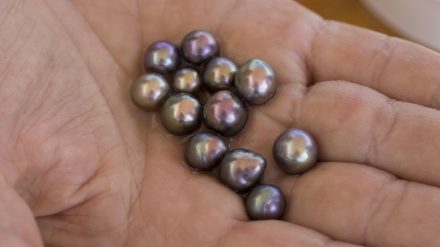
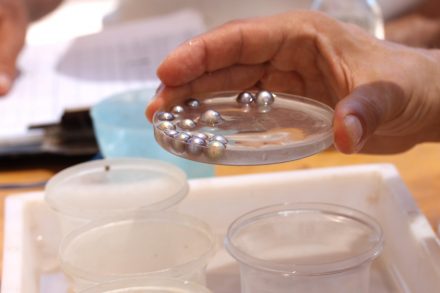
And these from bag # 2… I also “cherry picked” some pearls that had something that made them all the more strikingly beautiful or unusual and these are some pictures of these pearls:

However, these are not the only beautiful pearls, their colors are just much more intense, but these are other rare gems:

Now for the next sub-topic within the crop: the production of Mabe Pearls or “Half-Pearls”.


Mabe Pearl

This kind of pearl is “harvested” (extracted) from the shell of the oysters and -unlike loose pearls- they must be processed before being sold. In fact, this entire process is quite elaborate and I want to explain it in detail in a future Blog entry. I hope I can do this by September, as I am preparing a video of the process as well.

Since I am going to explain this in the near future, I will avoid going into much detail, but each pearl oyster has the potential to produce up to 3 Mabe(some rare ones up to 4), but we consider that only 50% of the extracted Mabe pearls will have the right quality to become a "Cortez Mabe"; what about the remaining pearls?… they will visit the mermaids (cast into the water’s depths). Why? Because we will simply not sell "junk pearls" to our customers and our pearls are guaranteed for life: we just don’t want people coming back to exchange a defective product, we want them to come back for more beautiful & enduring gems.

How many Mabe pearls did we harvest this year? According to harvest data we obtained 6,158 “raw” (or “in the shell”) pearls… from which we will further inspect and will end up with only 3,000 pieces of varying qualities: from "B" to "AAA" grades, and possibly some 6 “U” grade Mabe pearls.

Once mounted in jewelry, mabe pearls take on a completely different look …


Keshi Pearls and Natural Pearls

The natural pearl harvest this year was quite low, barely reaching 3 pearls with a size of at least 5 mm in diameter. This is a good number, considering that the norm in nature is of just 1 such natural pearl per every 10,000 pearl oysters.

Keshi pearls -a type of cultured pearl- were also very scarce, with an output of just 33 grams.

I hereby terminate this report of the Cortez Pearl Harvest of 2011.

The next blog post will be up by mid-September and will have information about the third edition of the "Pearl Ruckus" organized by Jeremy Shepperd (of “Pearl-Paradise.com” fame) which took place in Hollywood, California.

 
Until next time!